
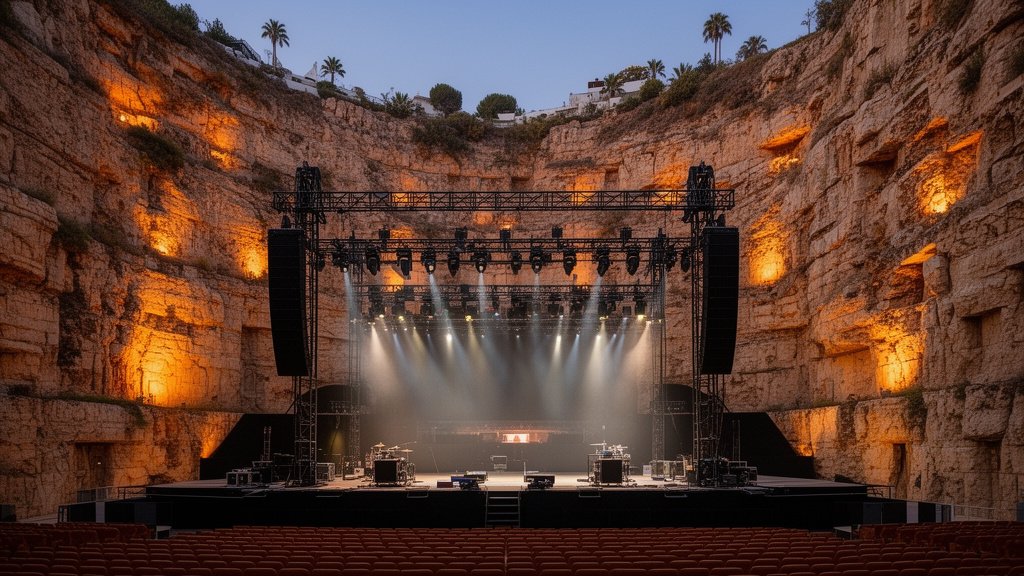
The landscape of Latin music is shifting across the Atlantic as Premios Juventud 2026 prepares to make history. In an unprecedented move that signals the global dominance of the genre, the annual celebration—long regarded as the most youthful and fan-driven spectacle in the industry—will take place at the iconic Auditorio Starlite in Marbella, Andalusia. This marks the first time in the event’s history that the ceremony has ventured outside the Americas, transforming a traditional homecoming into a bold, transatlantic statement about the borderless nature of modern music. As TelevisaUnivision prepares the stage in Spain, industry insiders and fans alike are bracing for a production that merges the vibrant energy of the Caribbean and Latin America with the sophisticated, open-air luxury of the Mediterranean coast.
Key Highlights
- Historic Venue Change: The ceremony is officially hosted at the Auditorio Starlite Marbella, Andalusia, Spain, a first-time exit from the Americas.
- Industry Scale: The production features a staggering 50 awards categories, highlighting the diversity and sub-genre expansion of Latin music.
- Competitive Field: A total of 338 nominees are vying for the coveted trophies, representing a massive roster of global talent.
- Fan-Centric Voting: Maintaining its core ethos, the awards continue to be driven by fan participation, ensuring that the winners truly reflect the pulse of the streaming generation.
The Andalusian Shift: Redefining Latin Music’s Global Reach
The decision to host Premios Juventud 2026 in Marbella is far from a mere logistical change; it is a calculated cultural strategy. By anchoring the event at the Auditorio Starlite—a venue renowned for its natural acoustics and deep-cut aesthetic—Univision is placing Latin music firmly at the center of the European festival circuit. For years, Spanish and Latin American artists have collaborated with European producers, creating a cross-pollinated soundscape that has topped global charts. Bringing the awards to Spain serves as a physical manifestation of this integration.
By the Digits: The Scale of the Ceremony
The sheer magnitude of this year’s event is captured in its statistics. With 338 nominees across 50 distinct awards, the breadth of coverage is exhaustive. This number is not just a metric of popularity but a testament to the hyper-fragmentation of the current music industry. From regional Mexican corridos to urban trap, and from classic salsa reimagined for Gen Z to avant-garde pop, the 50 awards reflect a granular approach to recognizing talent that larger, more traditional academies often overlook. The nominees, curated from every corner of the Spanish-speaking world, are set to descend upon Andalusia, turning Marbella into the temporary capital of the Latin music universe.
The ‘Starlite Effect’ and Regional Impact
The Auditorio Starlite itself acts as a character in this narrative. Known for its ‘bazaar’ style, nestled in a former quarry, it offers an intimate yet grand setting that contrasts sharply with the massive, sterile arenas where most awards shows are hosted. This choice of venue influences the production design: expect a focus on lighting, acoustics, and a more organic integration of the stage with the natural environment. Economically, the impact on Andalusia is projected to be significant, as thousands of industry professionals, media, and fans create a massive influx of cultural capital into the Costa del Sol region.
Historical Context: Transatlantic Cultural Exchange
Historically, the relationship between Latin American music and Spain has been cyclical. However, the last decade has seen a permanent shift. Latin music is no longer an ‘export’ from the Americas; it is a global dialect. Premios Juventud’s move to Spain acknowledges that the ‘Latin’ in Latin music now encompasses a European demographic that is consuming, creating, and influencing the genre at record-breaking speeds. By hosting the ceremony in Marbella, the organizers are closing the loop between the pioneers in the Americas and the new wave of European artists who are redefining the sound of the continent.
Voting Trends and Future Predictions
One of the most anticipated aspects of the 2026 edition is how the international location might influence fan voting. Historically, fan-voted awards have been dominated by regions with high mobile engagement. With the event physically located in Europe, there is widespread speculation about whether this will cause a surge in European fan engagement and voting numbers. If the European audience turns out in force, it could pivot the results toward artists who have heavy traction on both sides of the Atlantic, potentially reshaping the competitive landscape for future award seasons.
FAQ: People Also Ask
Why was the Auditorio Starlite chosen for Premios Juventud 2026?
The venue offers a unique, world-class outdoor setting that aligns with the premium aesthetic of the awards. Its location in Marbella, a hub for international tourism and culture, provides the perfect stage to bridge the gap between Latin American and European audiences.
Does moving to Spain change the eligibility criteria for nominees?
No. The eligibility for nominees remains consistent with the award’s standards, focusing on artistic impact, streaming performance, and commercial success within the Latin music industry, regardless of the artist’s country of origin.
How many awards are being presented this year?
There are 50 awards in total, covering a wide array of musical categories, social media influence, and cultural impact, with 338 nominees competing across these diverse fields.
Will the ceremony still be broadcast for audiences in the Americas?
Yes. Despite the physical location change, the event will be broadcast globally, with primetime scheduling adjusted to ensure that the primary audience in the Americas can tune in live, alongside the new European fanbase.