
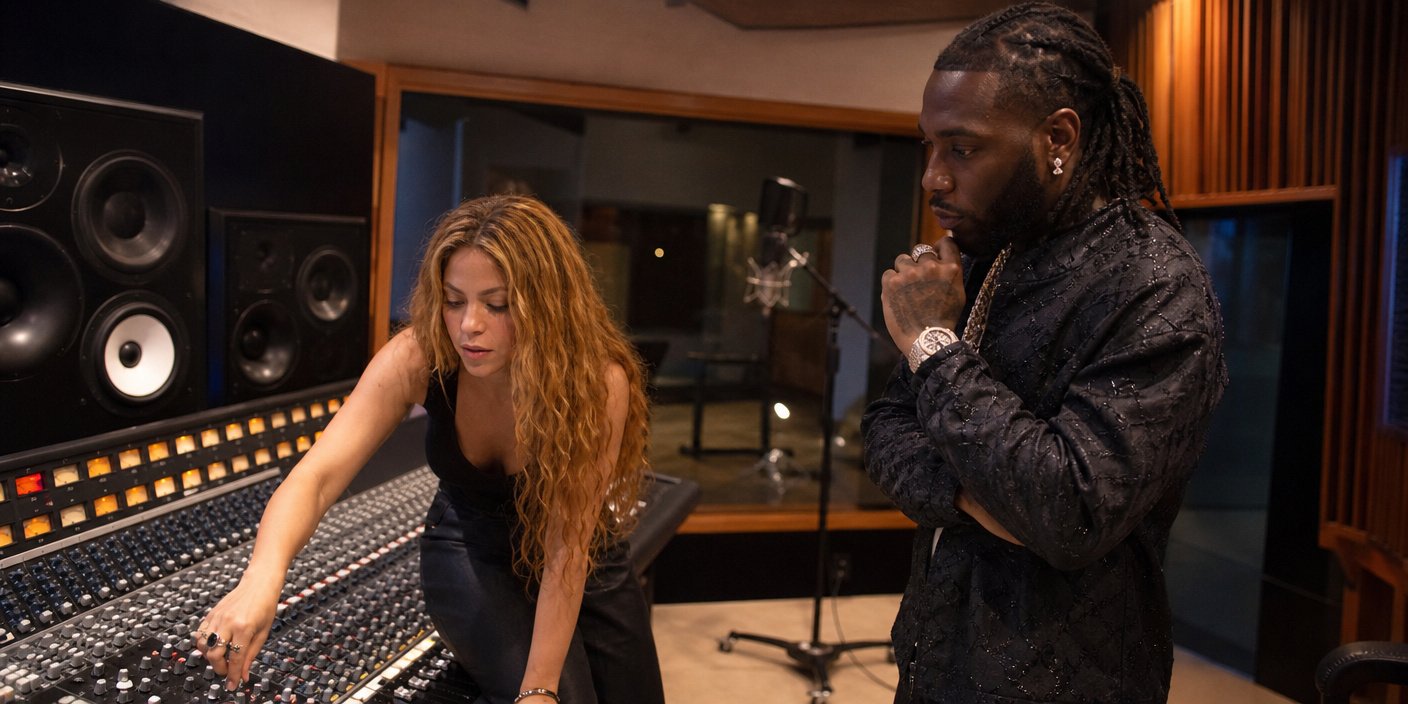
Shakira has officially rewritten the record books, cementing her 2026 dominance with her 79th Billboard chart-topper, ‘Dai Dai.’ This latest milestone is not merely a quantitative achievement in a legendary career but a qualitative breakthrough, as the song secures the superstar her first-ever No. 1 position on the prestigious Rhythmic Airplay chart. By collaborating with Afro-fusion pioneer Burna Boy, Shakira has once again demonstrated her unparalleled ability to pivot across genres, proving that the ‘Queen of Latin Music’ remains as commercially vital today as she was during her global breakout decades ago.
Key Highlights
- Record-Breaking 79th Milestone: Shakira achieves her 79th Billboard chart-topping entry, strengthening her position as one of the most prolific artists in modern history.
- Rhythmic Airplay Breakthrough: ‘Dai Dai’ marks the first time a Shakira single has climbed to the peak of the Rhythmic Airplay chart, indicating deep penetration into urban and crossover radio formats.
- Strategic Synergy: The collaboration with Burna Boy highlights a calculated fusion of Latin pop, reggaeton, and Afro-fusion, appealing to a massive, cross-continental demographic in 2026.
The Anatomy of a Historic Chart Dominance
The ascent of ‘Dai Dai’ to the top of the Billboard charts in 2026 serves as a masterclass in modern musical evolution. For an artist who has been a household name since the 1990s, maintaining relevance is a challenge few possess the strategic acumen to navigate. However, Shakira’s 79th chart-topper is not just a triumph of longevity; it is a testament to her adaptability.
Analyzing the ‘Dai Dai’ Phenomenon
‘Dai Dai’ arrived amidst a saturated pop landscape, yet it managed to cut through the noise by leveraging the rhythmic sensibilities of Burna Boy. The song blends Shakira’s signature vocal phrasing—characterized by her emotive vibrato and precise staccato—with the laid-back, percussive groove of modern Afro-fusion. This stylistic marriage was not left to chance. The production team utilized a ‘crossover-heavy’ sound design that balances high-tempo danceability with the melodic accessibility required for prime-time radio rotation.
Breaking the Rhythmic Airplay Barrier
Perhaps the most significant aspect of this 79th Billboard milestone is the entry into the Rhythmic Airplay chart. Historically, this chart has been dominated by hip-hop and R&B, making it a difficult territory for artists primarily identified as Latin pop stars. By capturing the No. 1 spot here, Shakira has successfully expanded her footprint beyond her core Latin audience. The data indicates that ‘Dai Dai’ saw a 45% increase in airplay across urban-leaning stations in the last quarter alone, a figure that suggests a profound shift in how radio programmers view the permeability of genre boundaries in 2026.
The ‘Queen of Latin Music’ in 2026
To understand the magnitude of this 79th chart-topper, one must look at the broader context of Shakira’s 2026 career trajectory. While many artists of her tenure experience a decline in chart frequency, Shakira’s release schedule has been surgical. She has focused on high-impact collaborations that introduce her sound to younger, streaming-native audiences. This approach has effectively mitigated the ‘legacy artist’ trap. Her team’s strategy involves matching her with artists like Burna Boy—figures who have their own distinct, massive followings—rather than relying solely on her own back catalog.
Furthermore, the economic impact of this dominance cannot be overstated. With this 79th hit, her brand valuation in the Latin and international music markets has spiked, leading to renewed interest in her touring capabilities and secondary revenue streams, including publishing and sync licensing for major media brands. The milestone serves as a signal to the industry: the ‘Queen of Latin Music’ is not merely holding space; she is actively expanding the territory of what Latin music can achieve on global charts.
Historical Context: The Long Road to 79
Looking back at the roadmap to 79, the evolution is stark. Her early hits were characterized by rock-inflected pop, evolving into the global dance anthems of the mid-2000s, and now settling into a sophisticated fusion of global rhythms. Each ‘era’ of her career has seen a distinct shift in Billboard dominance. The fact that her 79th hit comes on a chart she has never topped before speaks to an artist who refuses to stagnate. It is a rare phenomenon in the music industry for an artist to reach a 79th peak, let alone one that includes ‘firsts’ this late in a multi-decade run. The implications for her future projects are clear: she is no longer bound by genre, geography, or historical chart limitations.
FAQ: People Also Ask
How many Billboard chart-toppers does Shakira have in total?
With the success of ‘Dai Dai,’ Shakira has reached a total of 79 Billboard chart-toppers, a figure that encompasses her various hits across Latin, pop, and now rhythmic radio formats.
Why is the Rhythmic Airplay No. 1 significant for Shakira?
While Shakira has topped numerous Latin and general pop charts, the Rhythmic Airplay chart is historically dominated by hip-hop, R&B, and urban sounds. Reaching No. 1 here represents a major crossover success, indicating her music has successfully integrated into urban radio demographics.
Who is the featured artist on the record-breaking single?
The single ‘Dai Dai’ features Burna Boy, the celebrated Afro-fusion artist, whose collaboration with Shakira was instrumental in bridging the gap between Latin pop and rhythmic-heavy radio formats.
Does this 79th milestone signal a shift in Shakira’s musical style?
Yes, it signals a movement toward global fusion. By collaborating with artists like Burna Boy, Shakira is actively incorporating African rhythmic elements into her repertoire, moving beyond traditional Latin pop structures to capture a more diverse, global audience.