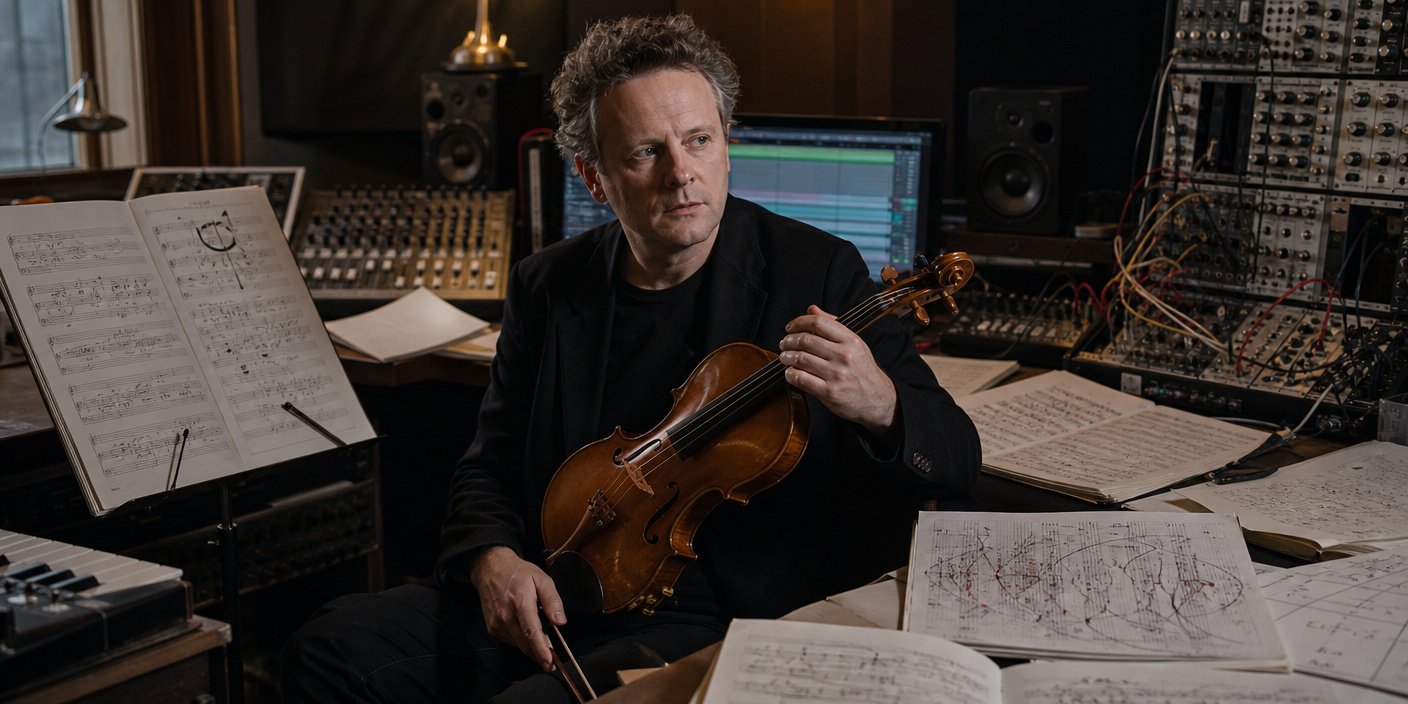
The Zarabanda Variations arrives not as a mere collection of tracks, but as an aggressive, intellectual audit of musical history. Composer and violinist Keir GoGwilt has constructed a project that serves as both a musical experiment and a pedagogical tool, forcing the listener to confront the sanitized, refined history of the sarabande. By dismantling the classical understanding of this dance form—which was, in its 16th-century colonial Latin American origins, a scandalous, fast-paced, and sexually charged expression of rebellion—GoGwilt strips away the powdered-wig aesthetic of the Baroque era to reveal the raw, rhythmic pulse that colonial powers sought to tame.
Key Highlights
- Reclaiming Origins: The album serves as a deep dive into the 16th-century Latin American origins of the sarabande, shifting the focus away from the sanitized European Baroque interpretation.
- Genre Fusion: GoGwilt masterfully layers free jazz improvisation over rigid Baroque string structures, creating a dialectic between freedom and form.
- Spoken-Word Integration: The project utilizes spoken-word poetry to narrate the violent and transformative history of the colonial encounter, acting as a bridge between the music and the archive.
- Sonic Deconstruction: The album challenges the listener to hear the sarabande as it was intended: a dangerous, socially disruptive dance rather than a stately courtly movement.
Deconstructing the Colonial Roots of Sound
The fundamental premise of The Zarabanda Variations is the concept of ‘musical colonialism.’ For centuries, musicologists have centered the sarabande within the Western canon, specifically focusing on its appearance in the suites of J.S. Bach or G.F. Handel. In these settings, the sarabande is slow, dignified, and contemplative. However, GoGwilt, drawing on rigorous historical research, insists on a different timeline. The sarabande began in the Americas, a hybrid form birthed from the collision of Indigenous, African, and European cultures. It was considered obscene by the Spanish Crown and the Catholic Church, leading to bans and attempts at censorship.
GoGwilt’s work functions as a restorative act. By employing free jazz—a genre inherently rooted in political liberation and the rejection of structural hierarchy—he creates a sonic environment that echoes the chaotic, transgressive energy of the dance’s original form. The dissonance of free jazz serves as a historical corrective, reminding the audience that the ‘Baroque’ sound we recognize today is, in fact, a domesticated, colonial artifact.
The Dialectic of Baroque and Improvisation
One of the most thrilling aspects of this project is the technical interplay between strict composition and unbridled improvisation. The strings often hold to the harmonic structures of the 17th century, maintaining a ghost of the original sarabande’s DNA. Yet, hovering over these structures are the jagged, unpredictable interventions of free jazz instrumentation. This is not merely a stylistic choice; it is a narrative strategy.
By layering these genres, the album demonstrates how history is often layered. The European classical tradition sits on top of, and often obscures, the subaltern history beneath it. When GoGwilt allows the jazz elements to overtake the strings, it feels like the past is erupting through the present. The listener is forced to sit in the tension of that overlap. It is a masterful use of musical form to represent historical erasure and subsequent recovery.
Poetry as the Historical Archive
Music alone, however, cannot tell the full story. The inclusion of spoken-word poetry is the album’s connective tissue. The texts weave together archival records, testimonials, and contemporary analysis, providing the listener with the ‘what’ and ‘why’ behind the sound. This spoken-word component transforms the album from a standard instrumental release into a multimedia narrative.
This approach aligns with modern critical theories of decoloniality. Rather than simply creating ‘fusion music,’ which can often flatten cultural nuances into a polite, homogenized sound, GoGwilt keeps the friction present. The poetry does not soften the edges; it adds the sharp, intellectual context required to understand why the sarabande was a site of struggle. It effectively turns the listening experience into an act of archival research.
Future Implications for Classical-Jazz Fusion
Looking ahead, The Zarabanda Variations establishes a new precedent for how artists might approach the ‘Baroque-fusion’ genre. For years, the intersection of classical and jazz has been dominated by ‘Third Stream’ concepts that often prioritize aesthetic elegance over political depth. GoGwilt’s work signals a shift toward a more aggressive, politically conscious engagement with history. We can expect to see more composers turning to archival research as a primary source for musical composition, using the concert stage as a space for historical interrogation. This project proves that classical music, when decoupled from its gatekeeping structures, can be a potent weapon for reclaiming narratives that have been buried by centuries of colonial silence.
FAQ: People Also Ask
Q: Is ‘The Zarabanda Variations’ considered traditional Baroque music?
A: No. While it heavily utilizes Baroque structures and instrumentation, the album intentionally subverts and deconstructs these traditions using free jazz and modern composition techniques. It is best described as a hybrid, avant-garde historical project.
Q: What is the significance of the sarabande in this context?
A: The sarabande is used as a case study for colonial erasure. The album highlights its transition from a ‘forbidden’ and ‘scandalous’ Latin American dance to a ‘refined’ European courtly dance, using this shift to critique historical sanitization.
Q: What role does spoken-word poetry play in the album?
A: The spoken-word elements serve as the historical narrative framework. They bridge the gap between the music and the archival facts, ensuring the listener understands the colonial context of the musical themes being explored.