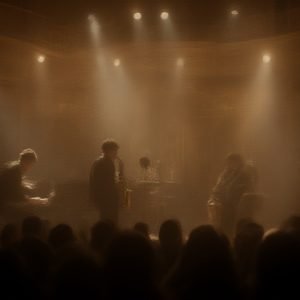

In the fast-paced ecosystem of modern Latin alternative music, few artists have captured the specific, suffocating tension of success as acutely as Carlos Hugo Reséndez, known globally as NSQK. With his latest project, ‘MOSCA’, the Monterrey-born artist moves beyond the confines of genre, delivering a conceptual masterwork that wrestles with the psychological cost of visibility. Drawing directly from the stark existentialism of Franz Kafka’s ‘The Metamorphosis’, NSQK’s latest offering is not merely an album; it is a clinical observation of the transformation one undergoes when the public gaze demands a version of oneself that no longer aligns with reality. As he navigates the industry’s complex machinery, NSQK challenges listeners to confront the dark side of chasing greatness—the isolation that often accompanies the peak of creative achievement.
Key Highlights
- Kafkaesque Framework: NSQK utilizes the narrative structure of ‘The Metamorphosis’ to articulate the dehumanizing experience of fame and the public’s changing perception of the artist.
- The ‘MOSCA’ Metaphor: The album title serves as a symbol for both the fragility of the artist and the intrusive nature of the external world, viewing the creator as something simultaneously observed and misunderstood.
- Existential Burnout: The project marks a pivot from previous works, trading purely stylistic experimentation for deep-seated lyrical vulnerability regarding mental health and career-driven isolation.
- Soundscape Shift: Production choices on the album reflect a ‘darker, grittier’ aesthetic, moving away from glossy, radio-ready production toward a more textured, industrial-leaning R&B sound.
The Anatomy of Transformation: Kafka, ‘MOSCA’, and the Artist’s Burden
To understand the gravity of ‘MOSCA’, one must first strip away the expectations of the streaming era. For many, the album cycle is a relentless, conveyor-belt process designed for consumption. For NSQK, however, the process has become a mirror to Franz Kafka’s seminal work, ‘The Metamorphosis’. Much like Gregor Samsa, who wakes up to find himself alienated from his own life and family, the artist argues that the process of scaling one’s career often leads to a similar displacement of identity.
In our exclusive synthesis of his creative discourse, NSQK posits that the ‘insect’ in his narrative is not a lack of talent or a failure of craft, but the invasive nature of fame itself. The title ‘MOSCA’ (The Fly) acts as a persistent, buzzing nuisance—a metaphor for the critical, sometimes parasitic, nature of the audience and the industry. When a creator is constantly under the microscope, they cease to be a person and become a specimen. This shift in perspective is audible throughout the album’s tracklist, which favors dissonance and sudden tempo changes, effectively jolting the listener out of their comfort zone.
The Industry’s ‘Dark Side’ of Chasing Greatness
There is a common narrative in the music industry that equates success with a linear trajectory: more plays, more money, more awards. NSQK dismantles this axiom, pointing to the ‘dark side of chasing greatness’—a sentiment that resonates with a growing cohort of artists feeling the squeeze of the algorithm. The pressure to remain ‘relevant’ while simultaneously maintaining a sense of self creates a cognitive dissonance that NSQK explores with almost painful precision.
He argues that the pursuit of a ‘great’ career often requires the shedding of parts of one’s humanity. In ‘MOSCA’, this is not portrayed as a necessary evil, but as a tragic transaction. The album’s lyrics delve into themes of solitude and the inability to communicate one’s internal state to the very people who listen to the music. It is a bold, introspective move for an artist at the height of his influence, signaling a desire to redefine the terms of his engagement with the public.
Musical Architecture and the Sonic Aesthetic
Beyond the lyrical weight, the technical production of ‘MOSCA’ serves as the anchor for its thematic darkness. If his previous work was the polish, ‘MOSCA’ is the underlying structure. The soundscape is deliberately claustrophobic, utilizing heavy low-end frequencies and sparse, isolated percussion that mimics the feeling of being trapped in a small, well-lit room. This is a deliberate choice: to make the listener feel the weight of the artist’s isolation.
We observe a significant departure from the maximalist production common in the current Latin pop landscape. Instead, NSQK leans into the ‘less is more’ philosophy, ensuring that every synthesized texture and vocal layering serves the narrative. By stripping back the unnecessary, he forces the listener to engage directly with the vocal performance, which carries a newfound, almost vulnerable, rawness. The album doesn’t ask for a dance; it asks for a conversation with one’s own shadow.
Secondary Angles: The Future of the ‘Auteur’ in Pop
1. The Algorithmic Response: How does an album rooted in, and critical of, the ‘public eye’ fare in an era where data-driven music often suppresses deeper artistic commentary? ‘MOSCA’ may serve as a test case for whether the industry—and the fans—are ready for ‘difficult’ art from established pop figures.
2. The Monterrey Vanguard: NSQK continues to cement Monterrey, Mexico, as a central node in the global alternative R&B and Pop circuit. His refusal to conform to traditional labels suggests a shifting power dynamic where regional artists are dictating the terms of their sonic identity rather than mimicking US or European trends.
3. The Longevity of the ‘Confessional’ Genre: With ‘MOSCA’, we are seeing a trend towards ‘radical vulnerability’—artists are no longer just singing about relationships, but about the structure of the business and the ego. This could signal a move toward more sustainable, career-long artistic arcs for independent-minded creators.
FAQ: People Also Ask
Q: What is the primary inspiration behind NSQK’s ‘MOSCA’?
A: The primary inspiration is the existential crisis depicted in Franz Kafka’s ‘The Metamorphosis’. The artist uses this classic literary framework to explore themes of isolation, loss of identity, and the intrusive nature of fame in the modern digital age.
Q: How does the album change the artistic trajectory for NSQK?
A: ‘MOSCA’ signifies a pivot from radio-ready pop/R&B toward a more conceptual, raw, and ‘dark’ sound. It marks a shift in his priority, moving from external success metrics to internal creative expression and vulnerability.
Q: What does the title ‘MOSCA’ actually represent in the album’s narrative?
A: The ‘MOSCA’ (Fly) represents the persistent, invasive nature of the public eye. It reflects the artist’s feeling of being a specimen under observation—small, misunderstood, and trapped within the context of their own success.