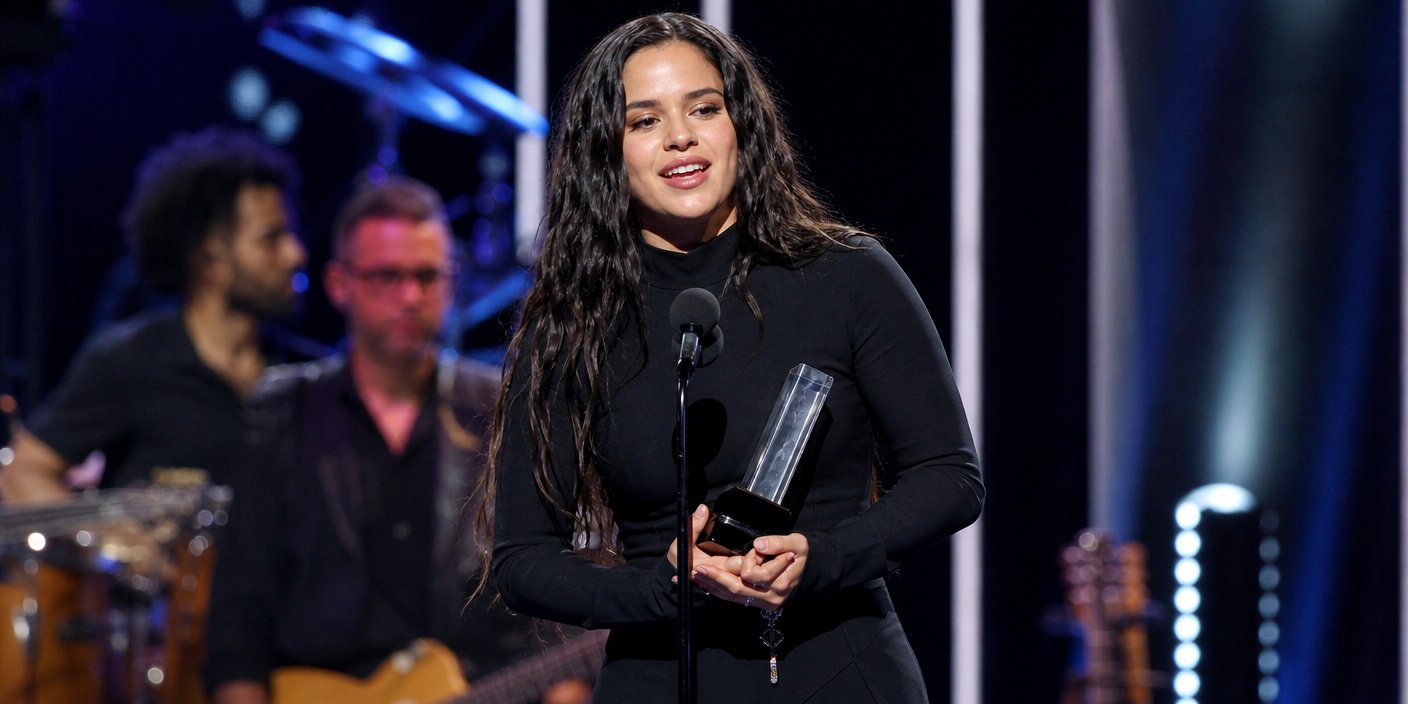
Rosalía, the visionary Spanish artist who single-handedly redefined the boundaries between traditional flamenco and avant-garde global pop, officially secured her place in music history by being inducted into the Billboard Latin Music Hall of Fame at the 2024 ceremony. This prestigious recognition, presented by the legendary Dominican songwriter and musician Juan Luis Guerra, was not merely an accolade for her commercial success but a testament to her profound impact on the cultural fabric of Latin music.
Key Highlights
- Historic Induction: Rosalía was formally honored with the Billboard Latin Music Hall of Fame award at the 2024 Billboard Latin Music Awards ceremony.
- Legendary Presentation: The award was presented by Juan Luis Guerra, one of the most influential figures in Latin music, underscoring the intergenerational respect Rosalía commands.
- A Tribute to Foundations: In her acceptance speech, Rosalía took time to honor the pioneers of the genre, specifically naming Celia Cruz, Daddy Yankee, and Juan Luis Guerra as fundamental influences on her artistic journey.
- Genre-Defying Legacy: The induction recognizes her unique ability to synthesize ancient flamenco traditions with modern urban aesthetics, a fusion that has propelled her to global superstardom.
The Intersection of Heritage and Innovation
The induction of Rosalía into the Billboard Latin Music Hall of Fame marks a significant milestone in her career, reflecting the rapid evolution of Latin music on the global stage. Standing on the stage at the 2024 Billboard Latin Music Awards, the contrast between the artist and her presenter, Juan Luis Guerra, was both striking and symbolic. Guerra, a titan whose compositions have defined the bolero, merengue, and bachata genres for decades, handing the award to Rosalía—a modern innovator—represented a symbolic “passing of the torch” in the ongoing narrative of Latin music.
The Anatomy of the Tribute
Rosalía’s acceptance speech was noted for its humility and historical literacy. Rather than focusing solely on her own commercial milestones, which include Grammy and Latin Grammy awards, she dedicated a significant portion of her moment to the architects of the soundscape that allowed her own career to flourish. By naming Celia Cruz, the “Queen of Salsa,” and Daddy Yankee, the pioneer of reggaeton, she acknowledged that her success is rooted in a continuum of excellence. She highlighted that without the stylistic risks taken by these predecessors, the cultural space for her own genre-fluid experimentation would not have existed.
The ‘Rosalía Effect’ on Global Pop
To understand the magnitude of this induction, one must look at how Rosalía has restructured the concept of a “pop star.” Following the release of her breakout project El Mal Querer and the subsequent global phenomenon Motomami, Rosalía demonstrated that an artist could maintain artistic integrity while achieving mainstream, cross-continental appeal. She brought the rhythmic complexity of flamenco—a deeply localized, historical art form—to stadiums in Tokyo, London, and New York.
This Hall of Fame induction acknowledges that her contribution was not just selling records; it was about expanding the vocabulary of pop music. Her work acts as a cultural bridge, proving that linguistic and genre barriers are no longer obstacles but opportunities for creative synthesis. This has set a new standard for Latin artists, encouraging a generation to lean into their roots rather than diluting them for international consumption.
The Evolution of the Latin Music Industry
The presence of luminaries like Juan Luis Guerra in the induction ceremony highlights a shift in how the Latin music industry perceives value. For years, the industry was often siloed by genre—salsa here, reggaeton there, pop elsewhere. The Billboard Latin Music Hall of Fame, in honoring Rosalía, is validating the “fusion artist.” This shift mirrors broader economic trends in the music industry, where streaming algorithms and global playlists have erased the hard lines between genres.
Rosalía’s success is an economic indicator of the massive viability of Latin music in the English-speaking market. By analyzing the trajectory of her career, industry analysts point to the power of authentic cultural branding. Her ability to collaborate with international artists while maintaining a Spanish-first output has proven that cultural authenticity is a high-value asset in the global marketplace. The induction serves as a formal “industry seal” on this business model, signaling to labels and investors that the future of Latin music lies in the hands of artists who respect history but are unafraid to dismantle it.
Looking Toward the Future
With this induction, the question for many industry observers is: what is next? Rosalía has already conquered the critical consensus and the commercial charts. As she enters the Hall of Fame, her role is shifting from a rising star to a foundational pillar. Artists coming up today, who draw inspiration from her blend of electronic, flamenco, and urban sounds, now have a clear roadmap. The legacy of the Billboard Latin Music Hall of Fame is essentially being rewritten in real-time, moving away from being a retrospective catalog of the past, and becoming a living, breathing guide to the future of music.
FAQ: People Also Ask
What is the Billboard Latin Music Hall of Fame?
The Billboard Latin Music Hall of Fame is a prestigious honor presented during the Billboard Latin Music Awards to artists who have made a significant, lasting impact on the Latin music industry, not just through record sales, but through cultural influence and genre innovation.
Why was Juan Luis Guerra the presenter for Rosalía?
Juan Luis Guerra is widely considered one of the most respected figures in Latin music history. His presence to present the award to Rosalía was a symbolic gesture of intergenerational validation, recognizing her as an heir to the artistic legacy he helped build.
Which artists did Rosalía mention in her speech?
In a move that drew widespread praise, Rosalía honored those who influenced her development, explicitly citing salsa legend Celia Cruz, reggaeton pioneer Daddy Yankee, and her presenter, Juan Luis Guerra, acknowledging their contributions as essential to her own artistic path.
Does this award affect Rosalía’s future music?
While the award is a look back at her accomplishments thus far, it confirms her status as a “legacy artist” in the eyes of the industry. This level of institutional support often provides artists with more creative freedom to experiment with their sound, as their foundational status is now firmly established.