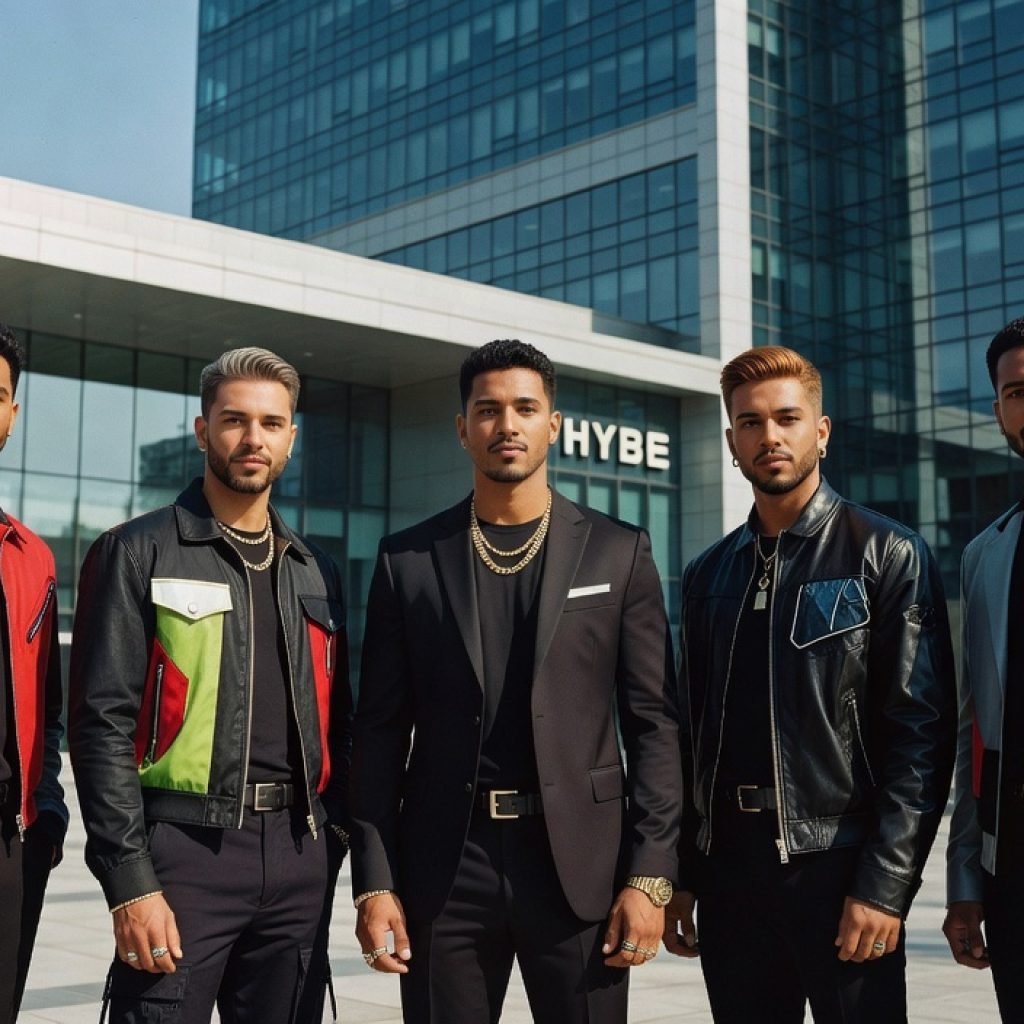
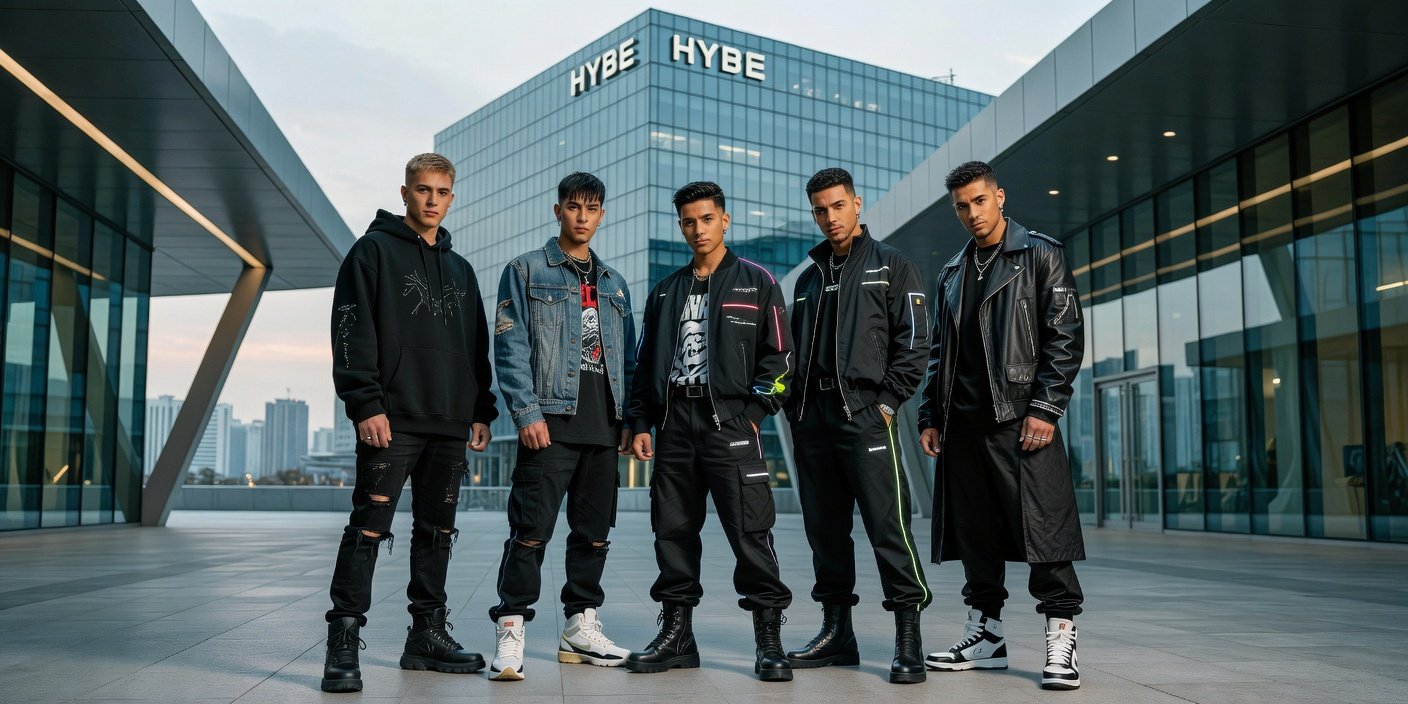
HYBE Latin America’s breakout boy band, Santos Bravos, has arrived in Seoul for their first high-profile media tour, marking a pivotal moment in the label’s “multi-home” expansion strategy. By blending the rigorous K-pop training methodology with vibrant Latin American musical flair, the group—Drew, Alejandro, Gabi, Kauê, and Kenneth—is positioning itself to replicate the global dominance of superstars like BTS and Bad Bunny. The visit to the headquarters of the Korean entertainment giant represents a significant milestone, solidifying the group’s status as a serious contender in the global pop music landscape.
Key Highlights
- Strategic Expansion: Santos Bravos serves as the flagship act for HYBE Latin America, proving the viability of the company’s “multi-home, multi-genre” business model.
- Cultural Fusion: The group combines K-pop’s synchronized choreography, high-production values, and trainee discipline with distinct Latin musical elements like reggaeton and Brazilian funk.
- Global Ambitions: Following their successful debut and EP release, the group is transitioning from a regional Latin act to a global brand, with a busy calendar of festival appearances across the Americas.
- Training Discipline: Members emphasize that the K-pop trainee system was instrumental in building their teamwork, perseverance, and artistic identity.
The New Blueprint for Global Pop
The arrival of Santos Bravos in Seoul is more than just a promotional tour; it is a manifestation of HYBE’s long-term vision to decentralize the K-pop production model. For years, the industry followed a linear path: Korean artists would train in Seoul, debut in Korea, and then attempt to crack international markets. With Santos Bravos, HYBE is flipping the script, transplanting the “K-pop Methodology” directly into the Latin American entertainment ecosystem.
Scaling the ‘K-pop’ Industrial Complex
At the heart of the group’s identity is their rigorous six-month training period. In the K-pop world, this time is spent mastering everything from vocal technique to dance, media relations, and brand management. When the members of Santos Bravos—hailing from Mexico, Peru, Puerto Rico, and Brazil—entered the program, they were essentially being indoctrinated into a standardized system that produces professional-grade entertainment.
This is not accidental. HYBE founder Bang Si-Hyuk has long championed a strategy where K-pop is defined not by ethnicity, but by the systematic approach to content creation. Santos Bravos acts as a living laboratory for this theory. By applying the same intensity that launched BTS to a group of Latin American artists, HYBE is betting that the quality and consistency of the ‘product’ will resonate with audiences regardless of the language they speak.
The ‘Santos Bravos’ Soundscape
Musically, the group occupies a unique niche. Their debut EP, Dual, is a deliberate exploration of contrasting sounds. Tracks like “0%” and “Kawasaki” demonstrate a sonic versatility that bridges the gap between the infectious, rhythmic nature of reggaeton and the polished, high-energy pop sensibilities typical of modern K-pop idols. This is strategic; it invites the massive Latin pop audience—accustomed to the likes of Bad Bunny or Karol G—into a world of performance-heavy, choreographically synchronized music that feels familiar yet distinct.
The Economic and Cultural Impact of Hybridization
The decision to host the group at HYBE’s headquarters in Yongsan District for the Korean press is a deliberate signaling event. It tells investors and fans alike that this is not a side project; it is a core asset.
Why the Latin Market?
Latin America has historically been a massive consumer of music, but until recently, the infrastructure to produce “idol-style” groups that compete with the global reach of K-pop was fragmented. By establishing HYBE Latin America, the company is capturing market share by professionalizing the local talent ecosystem. They are providing the resources—top-tier production teams like Johnny Goldstein, global collaborations, and intensive training—that were previously only available to the biggest solo artists.
Building a Pan-Latin Identity
One of the greatest challenges for the group has been defining a “pan-Latin” identity. Because the members come from diverse countries, they have had to synthesize their individual cultural backgrounds into a cohesive unit. The group’s ability to seamlessly switch between different regional influences—from Brazilian funk to Mexican pop—while maintaining a unified K-pop-style presentation is their primary competitive advantage. They aren’t just selling music; they are selling a lifestyle that feels inclusive to a massive, fragmented demographic.
Future-Proofing for Global Stages
Looking ahead, the group is aggressively expanding its presence. With appearances at major festivals like Estereo Picnic and Tecate Pa’l Norte, Santos Bravos is bypassing traditional radio and television promotion in favor of the “festival circuit,” a tried-and-true method for breaking new artists. They are also leveraging the power of reality television and docuseries, such as the detrás de DUAL (Behind DUAL) series on Spotify, to create parasocial relationships with their fanbase—a hallmark of the K-pop strategy that fosters deep loyalty.
FAQ: People Also Ask
1. Who are the members of Santos Bravos?
The group consists of five members: Drew (Mexican-American), Alejandro (from Peru), Gabi (from Puerto Rico), Kauê (from Brazil), and Kenneth (from Mexico).
2. What is HYBE’s ‘multi-home’ strategy?
It is an expansion strategy where HYBE adapts the K-pop production system (training, high-concept visuals, synchronized performance) to local markets outside of South Korea, effectively creating localized groups with global production standards.
3. How was Santos Bravos formed?
The group was formed through the 2025 reality competition show Santos Bravos: La Serie, which auditioned 17 trainees from across Latin America and the United States, culminating in a final five-member lineup.
4. Why is their visit to Korea significant?
It marks the first time the group has engaged with the Korean domestic media, bridging their Latin American origins with the headquarters of the company that developed their artistic methodology, symbolizing their full integration into the HYBE global roster.