
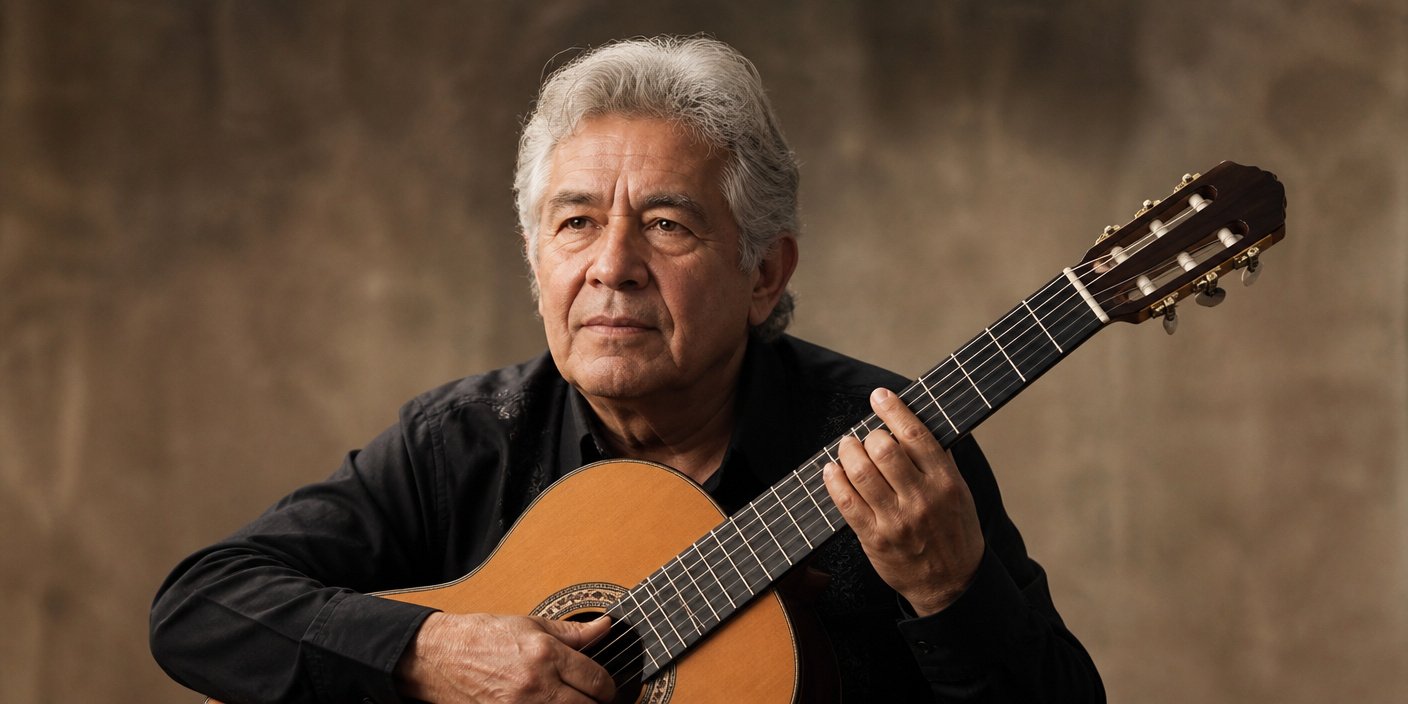
The world of Latin American protest music has lost one of its most enduring voices. Gabino Palomares, the celebrated Mexican singer-songwriter and committed social activist who became synonymous with the ‘Nueva Canción’ (New Song) movement, has passed away at the age of 76. His death follows a documented period of declining health, marking the end of a prolific career that spanned decades and defined the soundtrack of political awakening across Mexico and the wider region.
Key Highlights
- A Cultural Icon: Palomares was a foundational figure in the ‘Nueva Canción’ movement, which used folk traditions to advocate for social justice and anti-imperialism.
- Signature Anthem: He is perhaps best known for his poignant protest anthem ‘La maldición de Malinche,’ which remains a touchstone of Mexican identity and historical reckoning.
- Activist Legacy: Beyond his musical contributions, Palomares was a staunch advocate for indigenous rights, labor unions, and the democratization of Mexico throughout the late 20th century.
- Enduring Influence: His work bridged the gap between traditional folk roots and modern political commentary, influencing generations of Latin American artists.
The Resonant Legacy of a Revolutionary Troubadour
Gabino Palomares did not merely write songs; he crafted sonic documents of the Latin American struggle. Born in Comonfort, Guanajuato, in 1948, his artistic journey was intrinsically linked to the social upheavals of his time. As a prominent voice in the 1970s and 1980s, Palomares channeled the frustrations of a generation facing systemic economic inequality and political repression into melodies that were both haunting and empowering.
The Birth of the ‘Nueva Canción’ Ethos
At the heart of Palomares’s work was the ‘Nueva Canción’—a movement that rejected the superficiality of commercial pop music in favor of deeply rooted cultural narratives. This was not merely an aesthetic choice; it was a political stance. Alongside other regional luminaries such as Mercedes Sosa and Víctor Jara, Palomares understood that the guitar was a weapon for social change. He frequently performed in grassroots venues, university campuses, and protest sites, eschewing large commercial stadiums to remain close to the people whose stories he told.
His music often incorporated traditional acoustic instrumentation, reflecting the heritage of rural Mexico while addressing contemporary urban anxieties. This duality allowed his work to resonate equally with rural indigenous populations and the urban middle class, creating a rare bridge of empathy across disparate social strata.
‘La maldición de Malinche’: An Unending Anthem
It is impossible to discuss Palomares without addressing ‘La maldición de Malinche.’ The song serves as a lyrical autopsy of colonial legacy, exploring how external influences—both historical and modern—have shaped the Mexican psyche. With the haunting refrain asking, “¿Cómo vamos a dejar de ser extranjeros en nuestra propia tierra?” (How will we stop being foreigners in our own land?), Palomares articulated a pain that resonated far beyond his home country.
Decades later, the song remains a staple of social movements. Its inclusion in textbooks and its frequent use in modern political demonstrations highlight the timelessness of his message. Palomares’s ability to articulate the complexity of Mexican identity—a fusion of indigenous and Spanish heritages—made him not just an entertainer, but an intellectual force.
Beyond the Microphone: A Life of Activism
Palomares’s activism was never confined to the stage. He was deeply involved in the labor movement, frequently performing at strikes and public protests. His commitment to the ‘New Song’ movement extended to organizational roles, where he worked to preserve regional musical styles and ensure that younger generations had access to their own cultural history.
Throughout his life, he remained a vocal critic of neoliberal economic policies that he felt marginalized the poor, often using his influence to bring international attention to specific human rights abuses in Mexico. His transition into the digital age was marked by a continued dedication to his craft; even in his later years, he embraced the role of an elder statesman, mentoring young musicians who sought to carry the torch of social protest music into the 21st century.
Reflections on an Era
The passing of Gabino Palomares is more than the loss of an artist; it is a signal that a specific chapter of Latin American history is closing. The ‘Nueva Canción’ era, defined by its stark optimism and belief in the power of music to topple tyrants, is now a historical legacy. However, as global discourse faces new challenges regarding sovereignty, inequality, and cultural erosion, the themes Palomares championed remain startlingly relevant.
His departure invites a re-evaluation of his discography. From the somber ballads of the early 1970s to his later, more reflective works, Palomares’s evolution mirrors the maturation of the Mexican democratic process itself. While he will be remembered as a pioneer, his true legacy lies in the countless activists and artists who continue to cite him as the reason they picked up a guitar to demand change.
FAQ: People Also Ask
1. What is the ‘Nueva Canción’ movement?
‘Nueva Canción’ (New Song) was a powerful musical and social movement in Latin America during the 1960s and 70s. It blended folk music with protest lyrics to address political oppression, poverty, and cultural identity.
2. Why is ‘La maldición de Malinche’ so significant?
It is considered one of the most important protest songs in Mexican history. It critiques the lasting impact of colonialism and encourages Mexicans to take pride in their indigenous heritage rather than looking outward to foreign powers for validation.
3. Did Gabino Palomares win any major awards?
Throughout his career, Palomares was honored by numerous cultural institutions for his contributions to Mexican folklore and his role in the development of protest music. He was a revered figure in the Latin American literary and musical communities.
4. Where can I listen to his music?
His discography, including his landmark albums from the 70s and 80s, is available across most major digital streaming platforms, where his music continues to be archived and celebrated by musicologists and fans alike.