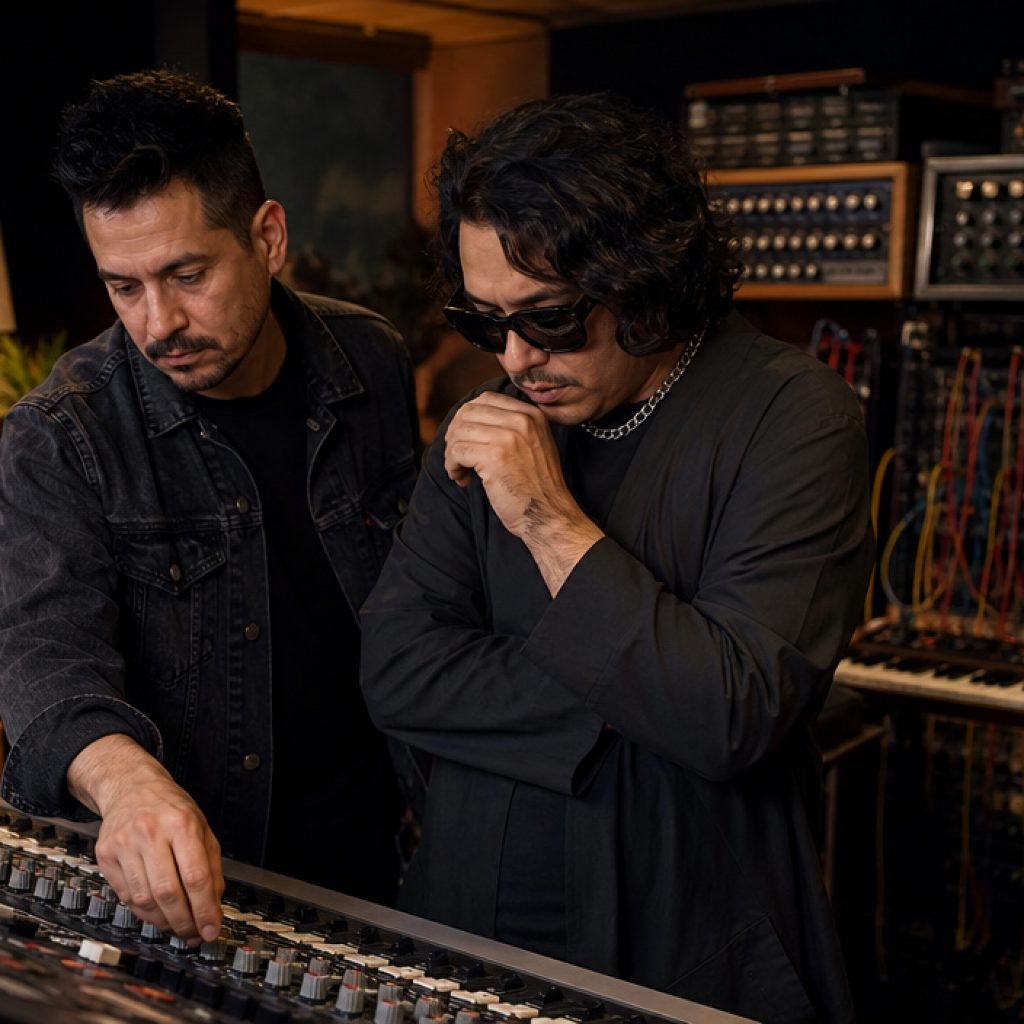

In a commanding display of musical synergy, the collaborative project ‘Ruido Tovar’ by the Mexican Institute of Sound (Camilo Lara) and the Meridian Brothers (Eblis Álvarez) has officially secured the No. 1 spot on the Transglobal World Music Chart for August 2026. The album, which serves as a vibrant homage to the sonic landscapes of Mexican tropical music from the late 1970s and early 1980s, has captivated audiences by balancing historical reverence with avant-garde production techniques.
Key Highlights
- Chart Dominance: ‘Ruido Tovar’ claims the No. 1 position on the prestigious Transglobal World Music Chart for August 2026.
- Artistic Fusion: A collaboration between Mexico’s Camilo Lara (Mexican Institute of Sound) and Colombia’s Eblis Álvarez (Meridian Brothers).
- Thematic Core: The album meticulously revives the ‘golden era’ of Mexican tropical music, focusing on the specific interplay between traditional instrumentation and early synth experimentation.
- Sonic Innovation: Critics and listeners are noting the album’s unique ability to blend vintage hardware sounds with contemporary dance floor sensibilities.
The Tropical Synth Revival: A Masterclass in Genre-Bending
The ascent of ‘Ruido Tovar’ to the top of the global world music charts is not merely a statistical victory; it represents a significant cultural moment for Latin American electronic music. For years, Camilo Lara of the Mexican Institute of Sound and Eblis Álvarez of the Meridian Brothers have operated as independent titans of their respective scenes—Lara with his penchant for sampling the eclectic history of Mexican pop, and Álvarez with his idiosyncratic, often surrealist take on tropical rhythms.
The Collision of Two Musical Minds
When the two artists announced their collaboration, industry observers anticipated a complex sonic landscape, but the final output has surpassed expectations. By isolating the specific era of the late 1970s and early 1980s, the duo has tapped into a ‘lost’ period of Mexican musical history where traditional cumbia and tropical rhythms first began to intersect with the rise of affordable, compact synthesizers. This collision created a distinct, somewhat grainy, and undeniably infectious sound—often referred to as ‘tropical synth’ or ‘electro-tropicalia.’
Unlike modern hyper-polished productions, ‘Ruido Tovar’ embraces the limitations and quirks of analog hardware. The use of synthesizers on this record is deliberate, mimicking the textures of Casio and Yamaha keyboards that flooded the Mexican market forty years ago. Eblis Álvarez, known for his ability to warp traditional sounds, brings a signature ‘Meridian Brothers’ touch: vocals that are processed, pitched, and layered to sound like half-forgotten memories emerging from a tape deck. Meanwhile, Camilo Lara provides the rhythmic backbone, ensuring that despite the avant-garde experimentation, the music retains its danceable, populist appeal.
Decoding the ‘Ruido Tovar’ Soundscape
To understand why this album has resonated so deeply with the Transglobal World Music Chart’s jury, one must examine the meticulous production. The album is not a cover record; it is a creative reconstruction. The tracks feature heavy use of drum machines that pay tribute to the classic ‘sonidero’ culture, where DJs would manipulate records to stretch or compress time, creating a hypnotic, unending rhythm.
Secondary Angle 1: The Preservation of 70s/80s Tropicalia
This album functions as a vital repository of cultural memory. By reviving these specific rhythmic and melodic structures, Lara and Álvarez are preserving a transitional period of Latin American music that was often overlooked by traditional folklorists and mainstream pop historians alike. It creates a bridge for younger audiences to explore the sonic roots of their parents’ generation, re-contextualized through modern synthesis.
Secondary Angle 2: Cross-Border Collaboration Dynamics
The success of ‘Ruido Tovar’ also underscores the evolving nature of trans-border musical collaboration. Despite the geographic distance between Mexico and Colombia, the project demonstrates how digital workflows allow for an instantaneous exchange of stems, ideas, and textures. This model of cooperation—where artists from different nations find common ground in niche aesthetic movements—is likely to become the blueprint for future high-level world music projects.
Secondary Angle 3: The Transglobal World Music Chart’s Influence
The chart itself plays a critical role in this success story. Unlike algorithms that prioritize established pop stars, the Transglobal World Music Chart is curated by a global panel of experts. Their validation of ‘Ruido Tovar’ provides a massive stamp of legitimacy, effectively functioning as a gatekeeper for global listeners seeking authentic, high-quality music that exists outside the dominant Anglo-American commercial sphere. This No. 1 status will undoubtedly translate into increased festival appearances and physical record sales in European and Asian markets where the Transglobal chart holds significant sway.
FAQ: People Also Ask
1. What does the title ‘Ruido Tovar’ refer to?
‘Ruido’ translates to ‘noise,’ and the title refers to a specific, almost mythical sonic atmosphere inspired by the tropical music era of Tovar, Mexico. It implies a ‘soundscape’ rather than just a collection of songs.
2. Is this the first time Camilo Lara and Eblis Álvarez have worked together?
While both artists share a mutual admiration and similar creative circles within the Latin alternative scene, this full-length collaborative album represents their most significant and sustained project to date, cementing their partnership as a major force in global electronic music.
3. Where can listeners find the specific sounds used in this album?
Much of the sound design is attributed to the use of vintage 1970s and 80s analog synthesizers. Fans of the sound should look into the history of ‘sonidero’ culture, which heavily influenced the percussive and synth choices throughout the album.
4. Will there be a tour to support the No. 1 release?
While no official tour dates have been confirmed as of August 2026, the industry expectation is that the album’s chart-topping success will drive high demand for live performances at major world music festivals globally.