
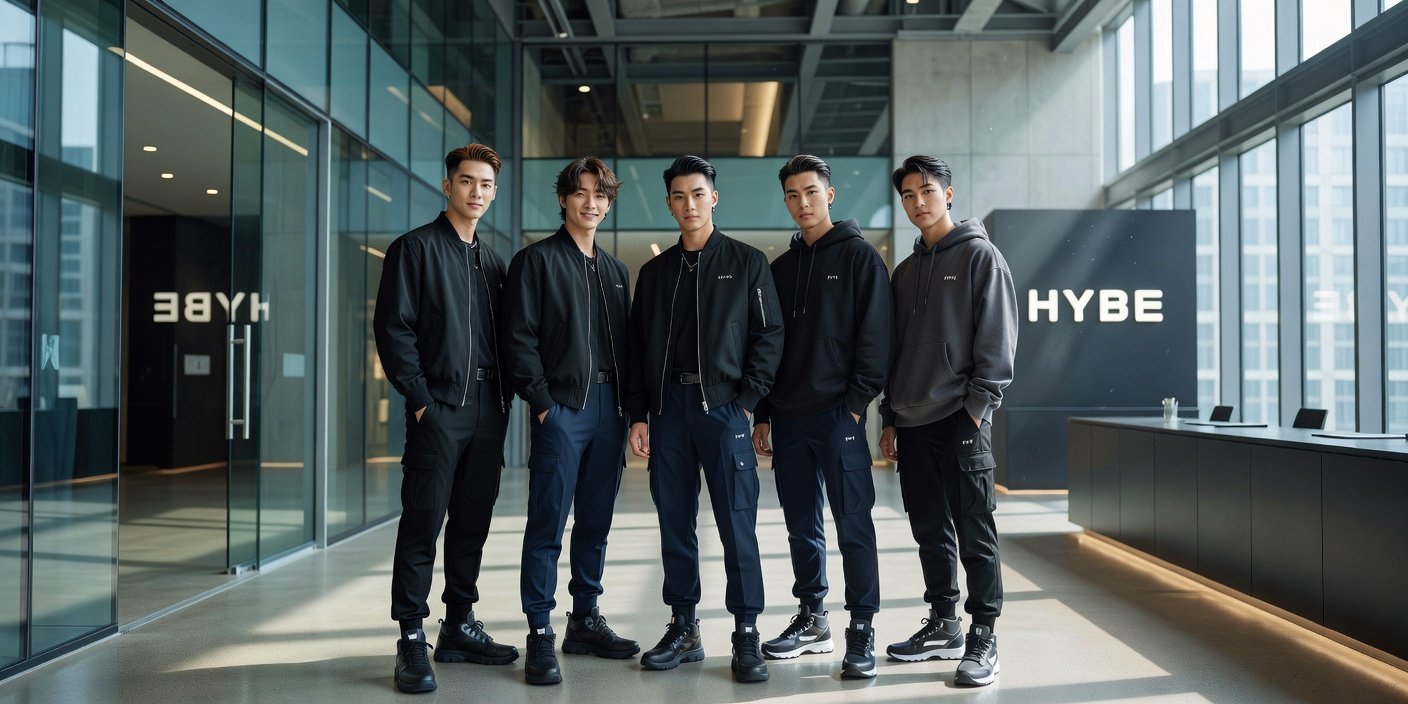
K-pop powerhouse HYBE’s first Latin boy band, Santos Bravos HYBE, has officially touched down in Korea—the heart of the industry that birthed their formation. Their arrival marks more than just a promotional tour; it represents a tangible milestone in Chairman Bang Si-hyuk’s ambitious “multi-home, multi-genre” initiative, which seeks to transplant the disciplined, rigorous K-pop training infrastructure into the vibrant and expansive Latin music market. Standing at the intersection of two of the world’s most influential musical cultures, the quintet—comprised of Drew, Alejandro, Gabi, Kauê, and Kenneth—is currently navigating the delicate balance of maintaining their Latin roots while adhering to the technical precision of the K-pop methodology, a key aspect of the Santos Bravos HYBE project and their global music strategy.
Key Highlights of the Santos Bravos HYBE Journey
- Global Expansion Strategy: Santos Bravos HYBE serves as the flagship experiment for HYBE’s “multi-home, multi-genre” initiative, testing the exportability of the K-pop production model and the potential of a Latin music hybrid.
- The K-Pop Playbook: The group underwent a rigorous, Korea-inspired training program, emphasizing discipline, teamwork, and idol-style performance management, a first for the Latin music industry, showcasing the unique Santos Bravos HYBE approach and the effectiveness of the K-pop training system.
- Musical Hybridization: Their recent EP, “Dual,” showcases a fusion of Latin pop’s groove and soul with the high-production polish and sharp choreographic precision typical of K-pop acts, a hallmark of the Santos Bravos HYBE sound and their multi-genre music offerings.
- Strategic Market Entry: The group’s visit to Seoul is part of a broader push to gain international recognition, with plans to bridge the gap between K-pop fandoms and Latin American audiences, a core element of the Santos Bravos HYBE global music strategy.
The Hybrid Blueprint: Integrating Two Worlds with Santos Bravos HYBE
The narrative surrounding Santos Bravos HYBE is not merely one of a rising boy band; it is a case study in corporate and cultural synthesis. When HYBE announced its entry into Latin America, many industry analysts questioned whether the specific, top-down management structure of K-pop—often criticized for its intensity—would gel with the more improvisational and expressive culture of Latin pop. The answer, at least according to the early results from the “Santos Bravos” reality series and their subsequent debut, is a resounding yes, highlighting the potential of the Santos Bravos HYBE model and the success of HYBE Latin America.
The Anatomy of the Santos Bravos HYBE Training System
At the core of the group’s development is the HYBE training ecosystem. In traditional Latin pop development, artists often rely on innate talent, regional street performance, or organic social media growth. Santos Bravos HYBE, however, was forged in a crucible of structure. For months, the five members—hailing from Mexico, Peru, Puerto Rico, Brazil, and the U.S.—endured a regimen that included vocal coaching, intensive dance rehearsals, and media training that mirrors what BTS or Seventeen underwent years prior. This “K-pop playbook” isn’t just about learning steps; it’s about establishing an identity as a cohesive unit for Santos Bravos HYBE, embodying the K-pop methodology.
Members have spoken openly about the difficulty of this adjustment. Gabi, hailing from Puerto Rico, noted in a recent Seoul press conference that the training pushed them mentally to a place that redefined their artistic limits. This discipline is the secret sauce that HYBE believes will allow Santos Bravos HYBE to transcend regional markets. By applying the same attention to detail—down to the precise angle of a finger-point in a choreography sequence—HYBE is attempting to standardize quality across its global portfolio, a key strategy for Santos Bravos HYBE and their global music strategy.
The Sound of ‘Dual’: A Santos Bravos HYBE Dual EP Review
Their first EP, “Dual,” released on March 13, 2026, is the physical evidence of this experiment. The tracks fluctuate between the upbeat, synth-driven sounds of modern K-pop and the reggaeton-infused rhythms that dominate the Latin charts. It is a calculated duality, a perfect example of the Latin music hybrid genre HYBE aims to create with Santos Bravos HYBE. The song “0%” serves as a manifesto of their group identity: it features the vocal agility of a Latin boy band but with the razor-sharp production value of a Korean idol track. Critics are already noting that the group avoids the trap of being a mere “K-pop cover band” by infusing the music with genuine Latin soul. The synergy suggests that HYBE is not just trying to clone K-pop, but to evolve it into a new, globalized genre through Santos Bravos HYBE.
The Strategic Vision: Why Latin America for Santos Bravos HYBE?
Chairman Bang Si-hyuk’s strategy is built on the realization that the K-pop bubble, while immensely profitable, has a natural ceiling if it remains exclusive to Korean artists. By “removing the K from K-pop,” as some industry observers have phrased it, HYBE is pivoting toward a future where the genre is a methodology rather than a nationality, a vision embodied by Santos Bravos HYBE and their global music strategy.
Economic and Cultural Impact of Santos Bravos HYBE
From an economic standpoint, Latin America is a goldmine. With streaming figures in the region skyrocketing and the global appetite for Spanish-language music at an all-time high (driven by icons like Bad Bunny and Karol G), placing a K-pop-trained group like Santos Bravos HYBE into this ecosystem is a logical, albeit risky, business move. It allows HYBE to secure a foothold in a market that is culturally distinct from their home turf, effectively insulating the company against market saturation in Asia, a key part of HYBE Latin America‘s expansion.
Future Predictions and Sustainability for Santos Bravos HYBE
Will this stick? The challenge for Santos Bravos HYBE will be longevity. K-pop bands are famous for their longevity, often spanning years of releases, tours, and evolving concepts. Latin pop, by contrast, is often more ephemeral, driven by singles and seasonal hits. The Santos Bravos HYBE project is a test of whether the “fandom culture” typical of Korea (deep loyalty, organized streaming, merchandise consumption) can be replicated among Latin American audiences who are historically more casual, mood-based listeners. If successful, this could rewrite the rulebook for international pop music, turning local idols into truly borderless, multi-regional superstars, a testament to the global music strategy of Santos Bravos HYBE.
FAQ: People Also Ask About Santos Bravos HYBE
Q: Who are the members of Santos Bravos HYBE?
A: The group consists of five members: Drew (Mexican American), Alejandro (Peru), Gabi (Puerto Rico), Kauê (Brazil), and Kenneth (Mexico). They are the pioneering Latin boy band from HYBE.
Q: How was the group formed?
A: Santos Bravos HYBE was formed through a competitive reality television series produced by HYBE Latin America and Telemundo, which aired from August to December 2025.
Q: Is Santos Bravos HYBE a K-pop group?
A: Not technically. They are a Latin pop group trained using the K-pop infrastructure. They operate under the “multi-home, multi-genre” philosophy, aiming to bridge Latin musical sensibilities with the technical precision of the K-pop industry, a core concept for Santos Bravos HYBE and their K-pop training system.
Q: Why is HYBE investing in Latin American talent?
A: The expansion is part of HYBE’s strategy to globalize the K-pop production model. By identifying regions with high musical output and dedicated fanbases, they aim to apply their proven training and management systems to cultivate global, rather than just local, superstars, a key driver behind the Santos Bravos HYBE initiative and the HYBE Latin America venture.