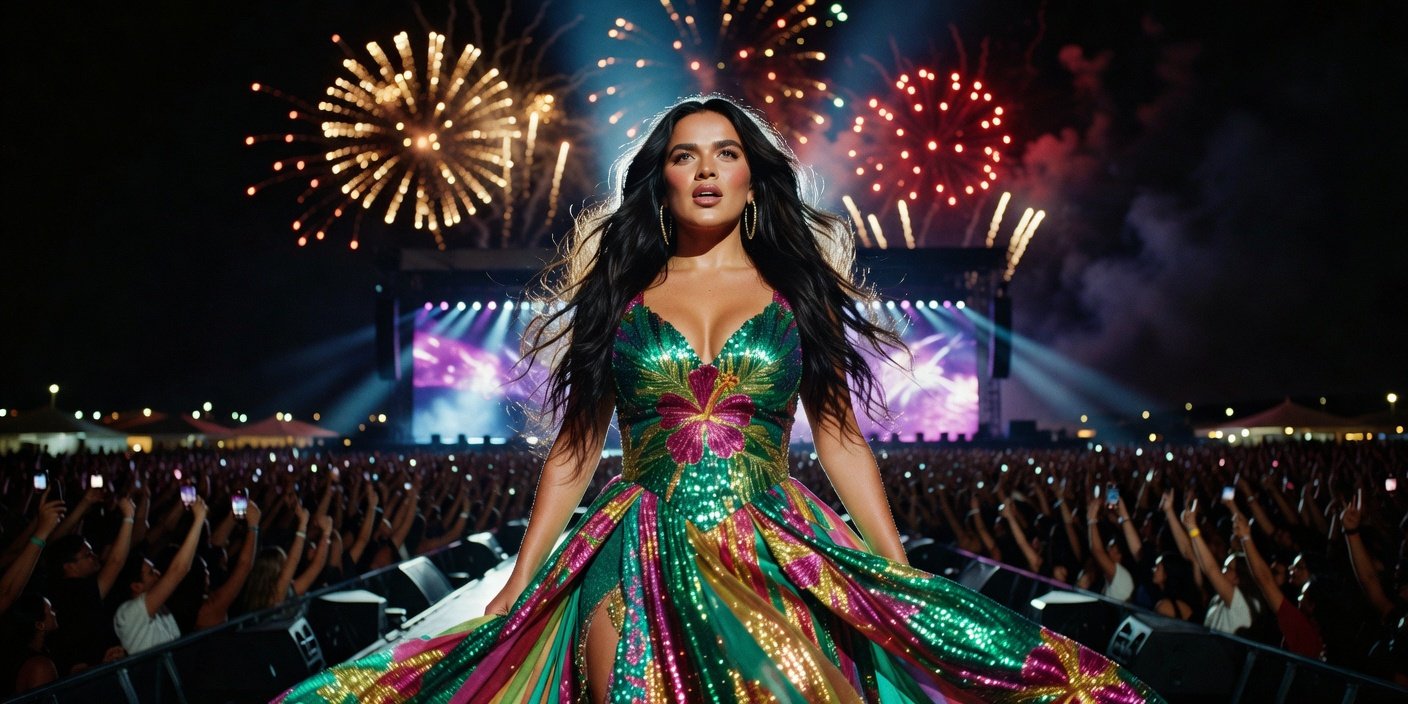
Under a kaleidoscope of fireworks and the roar of a capacity crowd at the Empire Polo Club, Karol G cemented her legacy this past weekend as the first Latina to headline the Coachella Valley Music and Arts Festival. The Colombian superstar’s set was a masterclass in cultural assertion, blending reggaeton, mariachi, and high-octane pop into a performance that felt like a reclaiming of space. Yet, even as the confetti settled on her triumphant exit, a more sobering narrative was unfolding behind the scenes: the American concert stage is becoming increasingly inaccessible for the rest of the world.
Key Highlights
- Historic Milestone: Karol G became the first Latina to headline Coachella in 2026, delivering a set that honored Latin American musical heritage alongside modern global pop.
- The ‘Chilling Effect’: Industry experts report a 17% drop in concert events in the first quarter of 2026, largely attributed to international acts bypassing the U.S. due to logistical and political hurdles.
- Visa Crisis: Escalating visa processing fees and unpredictable U.S. immigration policies are forcing mid-level and emerging international artists to cancel U.S. tours entirely.
- Economic Shift: Talent agencies and promoters warn that the U.S. is losing its status as the ‘must-visit’ touring market, with artists shifting their focus to Europe, Latin America, and Asia to avoid financial risk.
The Paradox of the American Stage
The duality of the current music landscape is stark. On one hand, you have the spectacle of Coachella, where Karol G commanded the main stage, proving that the demand for Latin music and globalized sounds has never been higher. Her set, which featured an all-female mariachi band and surprise appearances from diverse collaborators, served as a defiant counter-narrative to a political climate that has felt increasingly restrictive toward non-American performers.
However, this glitzy surface masks a systemic fracture. While the industry’s top 1% can afford the skyrocketing costs of expedited visa processing—which can run into the thousands of dollars per band member—the backbone of the touring ecosystem, mid-tier independent artists, are being priced out and locked out. Talent agents have reported that the financial burden of obtaining P-1 and O-1 visas, coupled with the unpredictable timelines, has rendered the U.S. an ‘unviable’ market for many European, African, and Asian acts who would have traditionally made the trek.
The Administrative Iron Curtain
The bureaucratic barriers for international musicians are not new, but they have intensified significantly in 2026. According to industry insiders and data from organizations like Pollstar, the hurdles have evolved from mere inconvenience to existential threats for smaller tours. The U.S. Citizenship and Immigration Services (USCIS) has faced mounting criticism for stringent evidentiary requirements, which often demand proof of ‘extraordinary ability’ that can be subjectively interpreted by officers with no background in the arts.
Moreover, the political climate has exacerbated these tensions. The fear of potential visa revocations or sudden border policy shifts has permeated the touring industry. Agencies are advising clients that a U.S. tour is a ‘high-risk investment’ rather than a guaranteed revenue stream. When a band cancels a 20-city tour due to a visa denial three weeks before departure, they don’t just lose ticket sales; they lose non-refundable deposits for buses, venues, and sound equipment, often resulting in devastating financial losses that threaten the band’s survival.
Economic Implications for Local Venues
It is not just the artists who suffer. Independent venues across the United States, which rely on a diverse roster of international talent to fill their calendars, are feeling the pinch. A music club in the Midwest that once hosted a steady stream of European indie bands, Latin ensembles, and Asian electronic acts is finding its calendar increasingly barren.
This decline is reflected in the 17% drop in Q1 2026 concert events noted by industry analysts. When international acts pull out, local promoters are forced to either leave dates empty or rely on a shrinking pool of domestic acts, which drives up booking costs and reduces diversity in local programming. As these venues struggle to maintain profitability, the cultural fabric of American cities—historically enriched by the free flow of international artistic exchange—is beginning to fray. The ‘chilling effect’ is real, and it is reshaping the soundscape of the American concert-goer.
The Future of Global Touring
As we look toward the remainder of 2026, the trend appears to be accelerating toward a bifurcated touring market. The largest artists—the ‘Karol Gs’ of the world—will continue to break records, utilizing massive resources to navigate any bureaucracy. But for the next generation of global stars, the United States is no longer the automatic destination of choice.
Markets like Mexico City, Bogota, London, and Tokyo are becoming more attractive, not just because of fan demographics, but because the path of least resistance has shifted. The United States must decide if it wishes to remain the cultural crossroads of the world or if it is content to become a walled garden, accessible only to those with the deepest pockets and the most predictable political profiles. Until visa processes are modernized and the fear of administrative reprisal is quelled, the roar of the Coachella crowd may serve as the exception rather than the rule for international artistry in America.
FAQ: People Also Ask
Q: Why are visa costs rising for international musicians?
A: Visa costs have risen due to a combination of increased base fees mandated by administrative rule changes and the necessity for most artists to pay for ‘premium processing’ to ensure visas are approved in time for tour dates, effectively creating a pay-to-play hurdle.
Q: Is Coachella still the gold standard for global talent?
A: Yes, it remains one of the most profitable and high-visibility festivals globally. However, organizers are increasingly having to engage in intense, high-stakes lobbying and logistical maneuvering to ensure their international headliners and supporting acts can actually enter the country in time for the show.
Q: How does this affect the average music fan?
A: Fans are seeing less variety in concert lineups. Smaller, niche, and international artists are disappearing from local venues, leading to more homogenous concert calendars and a lack of access to diverse global musical influences.
Q: Are other countries experiencing similar issues?
A: While touring is inherently complex, the specific, high-cost, and unpredictable nature of the current U.S. visa process is widely cited by international booking agents as being uniquely difficult compared to the Schengen Area or other major touring markets.