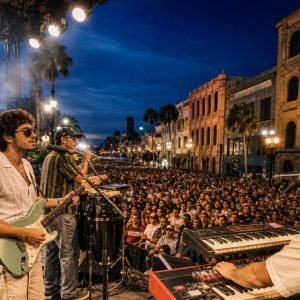

The Latin American rock scene has been set ablaze by what appears to be a calculated, strategic tease from one of its most seminal acts. La Ley, the Chilean rock titans who defined a generation of alternative music, have begun dropping cryptic hints on their official social media channels. These posts include precise geographical coordinates pointing directly to the Quinta Vergara, the legendary stage of the Viña del Mar International Song Festival. For followers of the band—which features the iconic trio of Beto Cuevas, Mauricio Clavería, and Pedro Frugone—the suggestion of a classic lineup reunion for the 2027 edition of the festival is not just a rumor; it is a long-awaited possibility that has already begun to shift the cultural conversation in Chile.
The Anatomy of the Tease: Decoding the 2027 Signal
The strategy employed by La Ley mimics a growing trend in the music industry: the ‘geo-tagging’ of future intent. By bypassing traditional press releases and moving directly to platform-native, cryptic imagery, the band has effectively captured the attention of their massive, multi-generational fanbase. The coordinates provided in their recent social media posts lead directly to the heart of the Quinta Vergara, the venue that has historically served as the ultimate litmus test for artistic success in Latin America.
This is not the first time La Ley has toyed with the idea of a reunion. Since their initial dissolution in 2005 and a high-profile return in 2014, the band has navigated a complex relationship with their legacy. The 2014-2016 reunion period, which saw them grace the stages of Viña del Mar once more, proved that the chemistry between Cuevas, Clavería, and Frugone remains potent. However, the hiatus that followed since 2016 has only heightened the scarcity of their presence, making any suggestion of a 2027 comeback exponentially more valuable in the eyes of promoters and ticket-buying audiences alike.
The Historical Weight of the Quinta Vergara
For a band of La Ley’s stature, a return to Viña del Mar is not merely a gig; it is a validation of their status as cultural icons. Throughout the 90s and early 2000s, La Ley served as the Chilean vanguard for the alternative rock movement. Tracks such as ‘Doble Opuesto’ and ‘El Duelo’ are woven into the fabric of Chilean pop culture. The Quinta Vergara amphitheater, with its capacity to house nearly 15,000 spectators and its history of being the ‘monster’ audience that can make or break an act, represents the highest stakes in the region. If the band is indeed eyeing 2027, they are positioning themselves at the center of the festival’s narrative.
Analyzing the ‘Classic Lineup’ Dynamic
The term ‘classic lineup’ carries significant weight in the industry. For La Ley, this specifically refers to the core trio who drove the band’s international commercial peak. During their previous reunion in 2014, the cohesion was evident, but so were the challenges of maintaining a creative collective after years of solo pursuits. Beto Cuevas, in particular, has established a formidable solo career, carving out a lane that blends his rock sensibilities with pop sensibilities. Integrating this into a band format requires a delicate balance of legacy material and the individual identities the members have cultivated in the interim.
The Economics and Culture of the Nostalgia Wave
To understand the magnitude of this potential reunion, one must look at the broader economic and cultural context of the Latin American ‘nostalgia circuit.’ We are currently witnessing an era where legacy rock bands are drawing larger, more profitable crowds than many contemporary pop acts. The ‘La Ley’ brand is historically robust, possessing a catalog that transcends the initial era of its popularity.
Secondary Angle 1: The ‘Nostalgia Economy’ and Market Viability
Promoters at festivals like Viña del Mar are increasingly reliant on legacy acts to anchor multi-day lineups. This creates a high-stakes bidding environment where the return of a band like La Ley functions as a ‘tentpole’ event. The economic impact of such a booking extends beyond ticket sales; it influences tourism, local hospitality, and television broadcasting rights, as the Viña festival remains a massive media event for Chilean television networks.
Secondary Angle 2: The Evolution of the Lead Vocalist
Beto Cuevas’ trajectory since 2016 provides a fascinating case study in how lead singers manage their brand. Moving away from the band environment allowed Cuevas to explore textures in his voice and songwriting that were perhaps constrained by the ‘La Ley sound.’ If a reunion happens, fans are not just hoping for a carbon copy of the 2000s, but a refined, evolved iteration of the band that honors the past while acknowledging the passage of time.
Secondary Angle 3: The Logistical Challenges of High-Profile Reunions
The logistics of reassembling a band that has been inactive for years are immense. Beyond the musical arrangements, there is the matter of scheduling. Major festivals like Viña del Mar require months of negotiation, technical rider fulfillment, and rehearsals. The cryptic nature of the current teasers suggests that discussions may already be in advanced stages, or at the very least, that the band is gauging the temperature of the market before committing to the rigorous demands of a festival-level performance.
FAQ: People Also Ask
Q: Has La Ley officially confirmed a reunion for the 2027 Viña del Mar Festival?
A: No, there has been no official press release or confirmation from the band’s management. The current buzz is based solely on social media activity and cryptic coordinate-based teasers.
Q: What is the significance of the 2027 date in the teaser?
A: The 2027 date is significant as it aligns with the festival’s milestone planning cycles, allowing organizers to build hype years in advance for what would be considered a ‘bucket list’ booking.
Q: Why does the ‘classic lineup’ matter?
A: The classic lineup (Cuevas, Clavería, Frugone) is the configuration fans associate with the band’s biggest international commercial successes. Any deviation from this trio would be seen as a significantly different project by the core fanbase.
Q: Where exactly do the coordinates point?
A: The coordinates point to the Quinta Vergara in Viña del Mar, Chile, the primary site of the International Song Festival.