In an era of deep political polarization, Brazilian music legend Joyce Moreno continues to serve as a vital cultural bridge, linking the turbulent history of her nation with the contemporary sounds of global jazz. With the release of her new collaborative project, Joyce & Tutty Moreno, produced by the renowned Adrian Younge via the Jazz Is Dead imprint, the singer-songwriter and guitarist is not only revitalizing the MPB (Música Popular Brasileira) genre but also issuing a stark warning to a new generation about the fragility of the democracy they have inherited.
Key Highlights
Collaborative Innovation: The new album, Joyce & Tutty Moreno*, marks a cross-generational fusion of bossa nova, samba, and modern psychedelic jazz, produced by Adrian Younge.
- Democratic Warnings: Drawing from her experiences living through the Brazilian military dictatorship (1964–1985), Moreno argues that younger Brazilians lack the lived memory of losing democracy, making them vulnerable to political complacency.
- Legacy of MPB: The record honors the creative ethos of the late João Donato, embedding his spirit into the complex harmonic structures that define the album’s soundscape.
- Artistic Resilience: Moreno discusses her lifelong battle to be recognized as a premier musical architect in a genre historically dominated by men, cementing her status as a global icon of artistic independence.
The Harmony of History and Resistance
The career of Joyce Moreno is a chronicle of Brazilian resilience. From her emergence in the late 1960s to her present-day stature as a global icon, she has navigated the shifting tides of Brazilian politics and the evolving landscape of the music industry. Her recent project with her husband, percussionist Tutty Moreno, and producer Adrian Younge is not merely a collection of songs; it is a declaration of continuity. The album stands as a testament to the idea that art, when crafted with integrity, can transcend the boundaries of time and political turmoil.
The Adrian Younge Effect
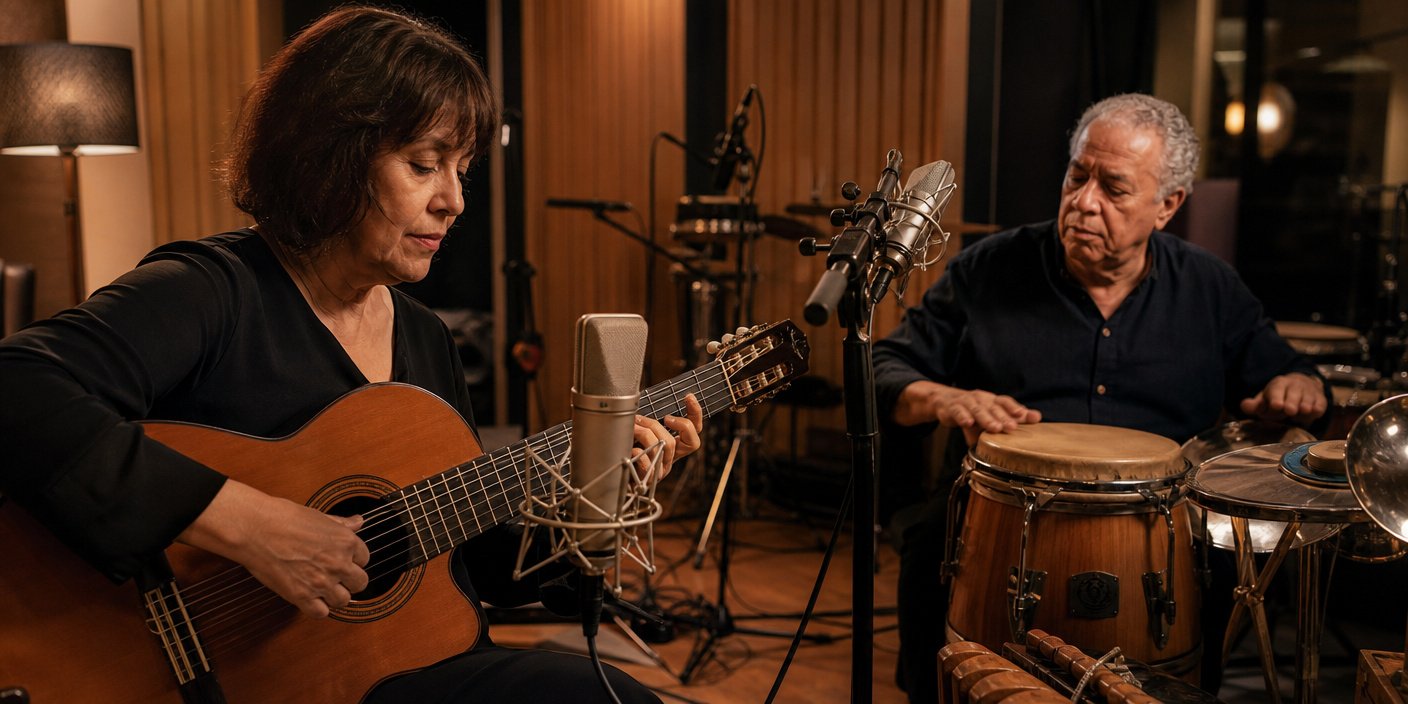
When Adrian Younge, known for his cinematic soul aesthetic and crate-digging approach, approached the Morenos for the Jazz Is Dead series, the intent was to capture the authentic, raw spirit of the couple’s decades-long partnership. For Joyce, this meant stepping into a studio where the focus was on the ‘vibe’ rather than perfection. The resulting sound is a masterclass in subtlety. The interplay between Tutty’s intricate percussion work and Joyce’s signature guitar style—often characterized by complex, percussive chords—is given a new, brooding texture by Younge’s production.
This collaboration brings MPB to a younger, international audience, proving that the genre is not a relic of the 1970s, but a living, breathing form of expression. In the studio, the sessions were less about rigid composition and more about capturing lightning in a bottle. As Moreno reflects, the music feels ‘immediate and urgent’—a stark contrast to the sterile, over-produced trends of modern pop music. It is, she insists, the sound of people who have lived enough to know that the most powerful music comes from the tension between joy and hardship.
Reckoning with Democracy
Perhaps the most poignant aspect of Moreno’s current discourse is her insistence on the precariousness of democracy. Having reached maturity under the shadow of the Brazilian military dictatorship, she witnessed the censorship, exile, and oppression that defined that era. Her perspective is one of hard-won wisdom. In recent interviews, she has articulated a concern that younger Brazilians—those who have grown up in the post-dictatorship era—often take their civic freedoms for granted.
To Moreno, the freedom to create, speak, and dissent is not a historical constant but a privilege that requires active maintenance. When she speaks of the ‘battles’ to become a great musician, she is not only referring to the industry sexism she faced as a woman in a male-dominated field, but also the societal pressures to remain silent in the face of political repression. Her music has always been a form of soft resistance, and today, she views that role as more critical than ever. The resilience she exhibits on stage is a mirror of the resilience she demands from the body politic.
Honoring the Legacy of João Donato
The presence of the late João Donato looms large over the new project. Donato, a titan of the piano and a close collaborator of the Morenos, was a cornerstone of their artistic development. In the writing and recording process, the ghost of Donato’s influence—his playful approach to rhythm and his refusal to adhere to standard musical conventions—is ever-present.
Moreno speaks of Donato not as a figure of the past, but as a guiding intelligence. By incorporating his stylistic DNA into the new album, the Morenos ensure that the lineage of Brazilian jazz remains unbroken. It is a way of saying that while the political climate in Brazil may fluctuate, the cultural bedrock remains firm. This deep, historical continuity serves as a counterweight to the instability of the current political moment, offering listeners a sense of grounding and perspective.
Beyond the Genre
Ultimately, Joyce Moreno’s recent work serves as a reminder that she is a composer first and a performer second. Her ability to synthesize the lyrical complexity of samba with the harmonic depth of jazz has allowed her to carve out a space that few others occupy. She has survived the ‘bossa nova’ trends, the ‘tropicalia’ movements, and the industry’s attempts to box her into specific categories. Today, she stands as a survivor in every sense of the word—artistically, culturally, and politically. As she continues to tour and record, her message remains clear: democracy, like music, requires constant practice, a keen ear for dissonance, and the courage to play one’s own tune even when the atmosphere is tense.
FAQ: People Also Ask
Q: How does the new album, Joyce & Tutty Moreno, differ from her previous work?
A: The album, produced by Adrian Younge, leans into a more atmospheric, cinematic, and raw sound profile. While it retains the core of bossa nova and MPB, Younge’s production introduces modern, gritty textures that differentiate it from the polished studio sounds of her 1990s and 2000s catalog.
Q: Why is Joyce Moreno considered a feminist icon in the music industry?
A: Throughout her career, starting in the late 1960s, Moreno broke barriers in the male-dominated Brazilian music scene by asserting herself as a composer, arranger, and bandleader—roles frequently reserved for men at the time. She has been vocal about the sexism she faced and has paved the way for future generations of female Brazilian artists.
Q: What is the significance of the ‘Jazz Is Dead’ series for Joyce Moreno?
A: The Jazz Is Dead imprint, helmed by Adrian Younge and Ali Shaheed Muhammad, focuses on revitalizing the legacies of jazz and soul legends. For Moreno, this platform provides a global stage to recontextualize her vast catalog and introduce her specific brand of Brazilian musicality to a younger, hip-hop-adjacent, and jazz-conscious audience.
Q: How did the Brazilian military dictatorship influence her music?
A: The military dictatorship (1964–1985) forced many Brazilian artists to use metaphor and lyrical ambiguity to bypass censorship. Moreno developed a songwriting style that was subtle and poetic, allowing her to express themes of freedom, love, and social commentary without triggering the authorities. This period instilled a deep appreciation for freedom that continues to define her public and political stance today.