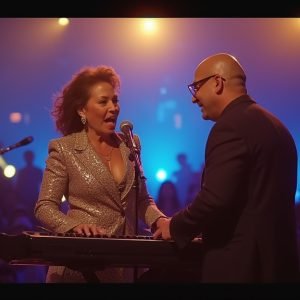
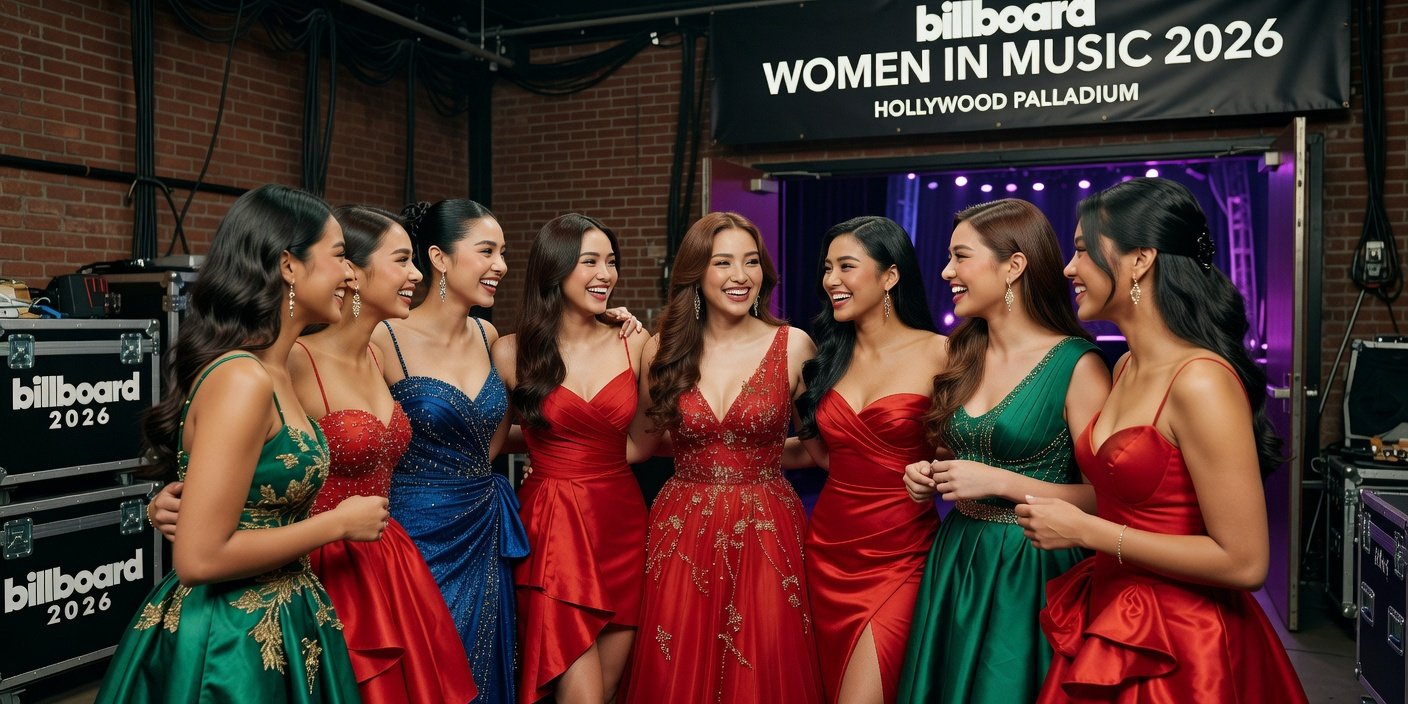
At the Hollywood Palladium during the Billboard Women in Music 2026 awards, two worlds of music collided in a moment that sent the internet—and particularly the Philippine music community—into a frenzy: the BINI Thalia Collision. The “Nation’s Girl Group,” BINI, had a chance encounter with Latin pop legend Thalia, a meeting that bridged a generation of cultural influence and highlighted the P-Pop global rise. The viral moment, captured on social media, showed the two acts connecting backstage, with Thalia playfully lip-syncing to her 1994 hit “Marimar,” effectively bringing together the stars of the 1990s telenovela era and the leaders of the 2020s P-Pop wave. This BINI Thalia Collision is a testament to the growing reach of Filipino artists and the exciting potential for cross-cultural collaboration.
The Historical Weight of the BINI Thalia Collision
To understand why this backstage interaction generated such significant buzz, one must look at the unique relationship between Mexican pop culture and the Philippines. For many Filipinos, Thalia is more than just a singer; she is a cultural icon. In the 1990s and early 2000s, Mexican telenovelas like “Marimar,” “Maria Mercedes,” and “Rosalinda,” all starring Thalia Marimar, were staples of Philippine television, drawing record-breaking ratings. This massive exposure turned Thalia into a household name, creating an “honorary Filipina” status that few international artists achieve. The BINI Thalia Collision taps into this deep-seated cultural connection.
For the members of BINI—Jhoanna, Stacey, Colet, Maloi, Sheena, Mikha, Aiah, and Gwen—who largely grew up in the digital age, this was a moment of witnessing history. While they might not have watched the original premieres of these telenovelas, they are acutely aware of the cultural footprint Thalia left in their home country. When Thalia greeted the group with “Mabuhay!” and expressed her deep, longstanding love for the Philippines, it wasn’t just a polite PR interaction; it was an acknowledgement of a multi-decade bond between a Latin superstar and a Southeast Asian nation, a bond now symbolized by the BINI Thalia Collision.
P-Pop’s Rising Global Trajectory and the BINI Thalia Collision
BINI’s presence at the Billboard Women in Music 2026 was the culmination of an extraordinary rise. The group, which was recently honored with the Global Force Award, has been on an aggressive and successful international trajectory. Their recent performance at Coachella, where they became the first all-Filipino girl group to grace the stage, signaled that P-Pop is ready to compete with K-Pop and other established global genres on the world stage, contributing to the P-Pop international movement. The BINI Thalia Collision further amplified this momentum.
Their interaction with Thalia, a seasoned veteran of the music industry who has successfully navigated the US and Latin markets for decades, serves as a masterclass in global visibility. For BINI, engaging with an artist of Thalia’s caliber provides not only social media engagement but a validation of their status as legitimate global contenders. The synergy between the two was palpable in the videos shared by the artists, where Thalia’s playful inquiry about a potential collaboration (“Should we do a remix?”) shifted the conversation from a simple photo-op to a genuine, highly-anticipated possibility, a true cross-cultural collaboration in the making, further cementing the significance of the BINI Thalia Collision.
The Mechanics of Cross-Cultural Fan Engagement and the BINI Thalia Collision
This event highlights a shifting paradigm in how music stars leverage social media to foster cross-cultural alliances. Thalia, recognizing the fervor of the Filipino fanbase, actively engaged with the “Marimar” narrative, a move that essentially unlocked the demographic engagement of a millions-strong fanbase. In the modern era, the “collab” is often less about the studio session and more about the digital footprint—the reels, the TikToks, and the social media reactions that precede the actual music. The BINI Thalia Collision is a prime example of this digital-first approach.
When Thalia posted the clip of herself with BINI to her millions of followers, she wasn’t just showcasing a friendship; she was amplifying BINI’s brand to a Latin-American and global audience that might otherwise be unfamiliar with P-Pop. Conversely, BINI’s fans (Blooms) have turned the interaction into a campaign, pushing for a collaborative effort that would merge Latin-pop sensibilities with contemporary Filipino sounds. This type of fan-led diplomacy is increasingly defining how international partnerships are formed, proving that audience enthusiasm is as much a currency as record label backing, and the BINI Thalia Collision has ignited this enthusiasm.
Economic and Cultural Implications of the BINI Thalia Collision
The potential for a collaborative project between BINI and Thalia carries significant weight. From an industry perspective, such a crossover would tap into two distinct but highly devoted markets. The Philippines remains one of the most engaged markets on social media platforms, often driving global trends. When combined with the massive Latin American consumer base, a joint track or project could bridge a significant gap in music distribution, potentially opening new avenues for future Philippine-Latin American entertainment ventures, echoing the Thalia Marimar impact. This BINI Thalia Collision could redefine music industry trends.
Furthermore, this meeting underscores the role of awards shows like the Billboard Women in Music event as “neutral ground” for international artists to network. These events serve as massive networking hubs where artists from different continents—often separated by language barriers and distinct music industry infrastructures—can meet, exchange ideas, and align strategies. For BINI, being in the same room as industry icons allows them to internalize the behaviors, marketing strategies, and career longevity that Thalia has modeled over her multi-decade career, a key aspect for Filipino artists international.
Future Outlook: From Backstage to Studio? The BINI Thalia Collision’s Legacy
While a formal studio collaboration has yet to be announced, the groundwork has been laid. Thalia’s “If you invite me” response to the prospect of a collaboration has effectively challenged the group’s management to make it happen. In the world of modern pop, such public statements are rarely made without an underlying willingness to explore the possibility. If a collaboration were to manifest, it would represent a landmark moment in P-Pop history: a direct, high-profile bridge between two of the world’s most passionate music-consuming cultures, solidifying the BINI Thalia Collision as more than just a fleeting moment.
For now, the fan base remains in a state of high anticipation, dissecting every frame of the backstage footage for clues. Yet, regardless of whether a record is released, the event has already succeeded in its primary objective: highlighting the globalization of Filipino talent. BINI has shown that they are not just capable of performing on international stages, but that they can command the attention of global icons, solidifying their place in the ongoing conversation about the future of international pop music. The BINI Thalia Collision has undoubtedly accelerated this conversation.
FAQ: People Also Ask
Why is Thalia so famous in the Philippines?
Thalia is considered a cultural icon in the Philippines due to the massive success of her telenovelas, particularly “Marimar,” “Maria Mercedes,” and “Rosalinda,” which aired in the 1990s. These shows achieved extremely high ratings, making her a household name across the country, a phenomenon that the BINI Thalia Collision has reignited interest in.
What award did BINI receive at the Billboard Women in Music 2026?
BINI was honored with the Global Force Award at the Billboard Women in Music 2026, held at the Hollywood Palladium, recognizing their rapid rise and influence in the global music industry.
Is a collaboration between BINI and Thalia confirmed?
As of now, there is no official confirmation of a musical collaboration stemming from the BINI Thalia Collision. However, the interaction was extremely positive, with Thalia publicly suggesting a remix and BINI expressing strong enthusiasm for the possibility, leading to widespread speculation and fan campaigns.
What was the context of the Thalia and BINI meeting?
They met backstage at the Billboard Women in Music 2026 event in Los Angeles. The interaction was organic, fueled by mutual respect and Thalia’s recognition of her Filipino fanbase, resulting in a viral social media video that has become known as the BINI Thalia Collision.