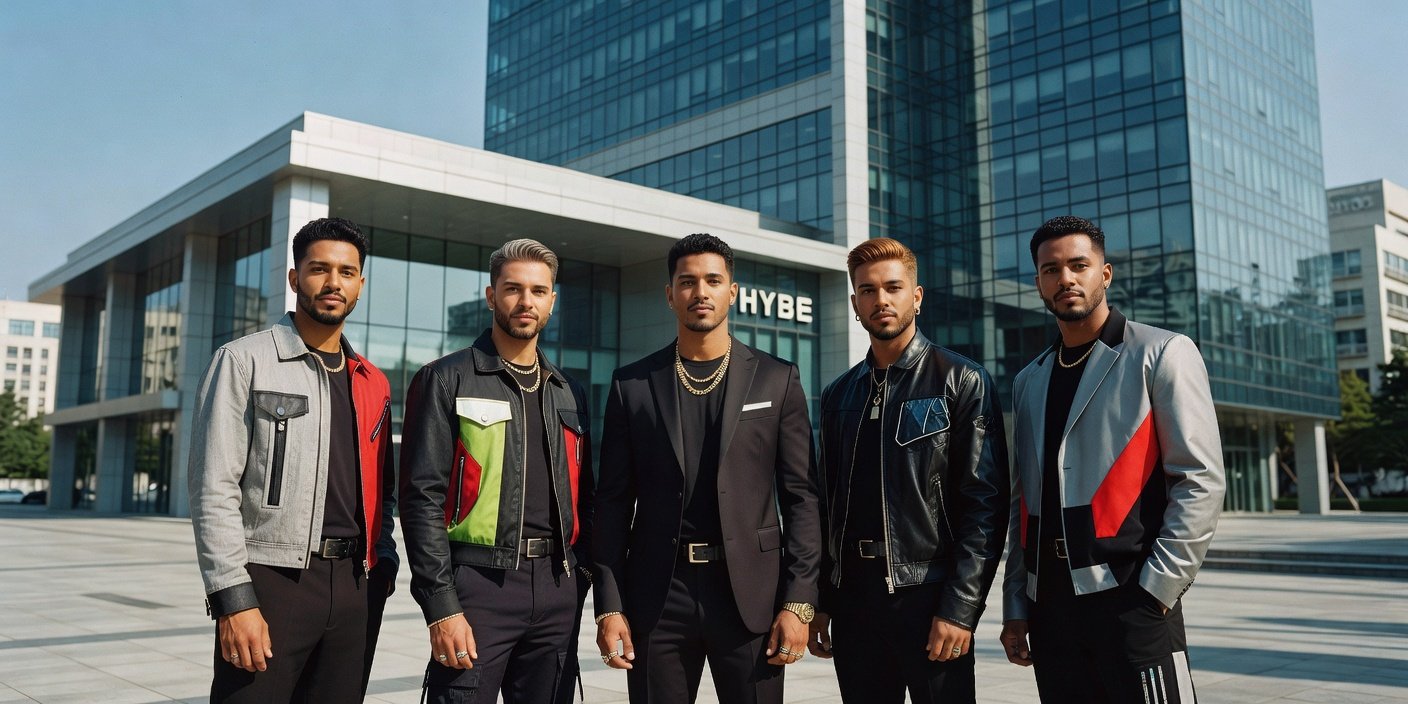
In a historic moment that underscores the globalization of the K-pop production model, Santos Bravos—the inaugural Latin American boy band formed under the HYBE umbrella—officially descended upon Seoul this week for a high-profile media takeover. Following their October 2025 debut in Mexico City, the five-member group (comprised of members Drew, Alejandro, Gabi, Kauê, and Kenneth) is currently navigating the heart of the Korean entertainment industry, treating the trip not merely as a promotional tour, but as an intensive educational residency at the epicenter of their creative lineage. By blending the rhythmic soul of Latin pop with the rigorous, synchronized discipline of K-pop, Santos Bravos has become the living embodiment of HYBE’s ‘multi-home, multi-genre’ strategy, challenging industry veterans and audiences alike to rethink the boundaries of modern music.
Key Highlights
- The K-Latin Fusion: Santos Bravos is the first group to fully integrate the ‘K-pop methodology’—including the intense trainee system—with Latin American cultural identity.
- Strategic Seoul Residency: The group is currently in Korea for a three-week promotional blitz, appearing on local music shows and radio programs to solidify their standing in the home of their label’s origin.
- ‘Dual’ Identity: Their first EP, ‘Dual’ (released in March), serves as a stylistic manifesto, oscillating between the softer ‘Santo’ and the more aggressive ‘Bravo’ sides of their musical persona.
- Global Ambitions: The members, hailing from Mexico, Peru, Puerto Rico, Brazil, and the U.S., explicitly cite senior HYBE acts like BTS and Le Sserafim as their guiding influences, aiming to translate K-pop’s global dominance into the Latin American market.
The K-Latin Blueprint: Redefining Pop Boundaries
The arrival of Santos Bravos in Seoul is not just a standard promotional stop; it represents a calculated evolution of HYBE’s corporate strategy. For years, the ‘K-pop’ label has referred as much to a production system—characterized by intense training, high-concept visuals, and aggressive performance synchronization—as it has to a geographical origin. With Santos Bravos, HYBE is successfully decoupling the methodology from the nation. By embedding this system into the Latin American context, the company is attempting to create a new category of ‘Glocal’ pop (Global + Local) that feels native to its target audience while maintaining the polished, high-octane sheen of a K-pop idol group.
The ‘Multi-Home’ Strategy and Bang Si-hyuk’s Vision
At the core of this project lies the ‘multi-home, multi-genre’ strategy spearheaded by Chairman Bang Si-hyuk. The underlying theory is that if the K-pop production framework can create stars that transcend cultural boundaries in Korea, it can be exported to other fertile music markets like Latin America. The members—Drew (Mexican American), Alejandro (Peru), Gabi (Puerto Rico), Kauê (Brazil), and Kenneth (Mexico)—were selected not just for their talent, but for their ability to represent a pan-Latin identity that could connect with fans from Buenos Aires to Los Angeles and now, remarkably, to Seoul.
Industry analysts have noted that the success of this group is critical for HYBE’s long-term hedging against the saturation of the domestic Korean market. By creating groups that can operate within their own regional ecosystems (Latin America) while still retaining the prestige and technical quality of the K-pop brand, HYBE effectively diversifies its revenue streams and mitigates dependency on any single regional market. Santos Bravos is the pilot program for this evolution, and their ability to sell out the Auditorio Nacional in Mexico City upon debut suggests that the strategy is resonating.
Analyzing the ‘Dual’ Identity
Released in March, the EP ‘Dual’ is the clearest articulation of the group’s artistic goals. It is a tight, six-track project that attempts to reconcile two seemingly opposing creative forces: the melodic, groove-heavy nature of Latin pop and the sharp, rhythmic precision of K-pop. Tracks like ‘MHM’ offer a softer, more melodic entry point, while ‘Velocidade’ leans heavily into the Brazilian funk and intense club sounds that are dominating global playlists.
This duality—’Santo’ for the soft, ‘Bravo’ for the intense—is a clever branding device. It allows the group to pivot between radio-friendly pop ballads and high-energy stage performances without losing their cohesive identity. During their Seoul media roundtable, the members emphasized that this was not accidental. They described the training process as one of ’emotional and physical endurance,’ where they had to learn not just how to sing and dance, but how to perform with the hyper-awareness of K-pop idols while maintaining the natural, free-spirited ‘groove’ expected in Latin music.
The Cultural Crossover: Learning as Students
One of the most intriguing aspects of the group’s visit is their stated goal of ‘learning.’ While the group has already achieved notable milestones—including a spot at Paris Fashion Week and guest appearances with Shakira—they consistently frame their visit to Korea as an opportunity to study at the source. This humility is a staple of the K-pop training system: the constant drive for improvement.
By engaging with the Korean media ecosystem, performing on domestic music shows, and interacting with senior HYBE groups, Santos Bravos is reinforcing the legitimacy of their hybrid status. They are effectively asking Korean audiences to accept them as peers, not just as a derivative of their system. This is a delicate balance. If they seem too ‘manufactured,’ they risk losing the authenticity that the Latin music market values. If they seem too ‘Western,’ they risk failing the rigorous standards of the K-pop fanbase. So far, the data suggests they are succeeding at navigating this narrow path.
Future Predictions: The Scalability of the Model
Looking ahead, the success of Santos Bravos could pave the way for similar projects in other regions. If the ‘K-pop methodology’ can be successfully adapted to Latin music, why not to Indian Pop, Southeast Asian Pop, or even Western Pop? The blueprint involves identifying a high-growth market, sourcing local talent, applying a rigorous, centralized training regimen, and leveraging a global marketing distribution platform.
However, the challenge lies in the ‘soul’ of the music. Latin music is inherently driven by spontaneity and regional authenticity. The K-pop model is often criticized for being overly controlled and manufactured. The long-term challenge for Santos Bravos will be to ensure that the ‘system’ does not suffocate the ‘expression.’ If they can maintain the grit and passion of their roots while utilizing the polish of their training, they will not only be a successful project for HYBE—they will be the architects of a new, globalized pop paradigm.
FAQ: People Also Ask
1. Who are the members of Santos Bravos?
The group consists of five members: Drew (Mexican American), Alejandro (from Peru), Gabi (from Puerto Rico), Kauê (from Brazil), and Kenneth (from Mexico).
2. How was Santos Bravos formed?
They were formed through a reality survival program created by HYBE Latin America, which selected the final five members from trainees across Latin America, the United States, and Spain after a rigorous six-month training period.
3. Is Santos Bravos considered a K-pop group?
They are classified as a ‘Latin pop’ group under the HYBE umbrella. While they utilize the K-pop training system and production methodology, their music is rooted in Latin genres like reggaeton, funk, and club music, aiming to blend both cultural worlds.
4. Why is Santos Bravos visiting Korea?
The group is visiting Korea for a three-week promotional tour to appear on local music shows, radio programs, and to engage with the Korean media, effectively marking their official entry into the K-pop industry’s home base and learning from their senior labelmates.